Monday, April 12, 2021

Flash Review — Black Sonata


Players
: 1
Age: 12+
Playtime: 30 min
Complexity: low-med

A solo game of deduction and hidden movement, with quite the original theme: you’re roaming 17th century London, trying to ascertain the identity of the “Dark Lady” Shakespeare refers to in several of his sonnets.
Track down the Dark Lady, try to get a glimpse at her to obtain clues about her identity, then state your conclusions out loud (even though it’s just you in the room) and check whether you’re right.

Black Sonata stands as one of most devilishly clever games I’ve ever encountered. The game runs on a deck of movement cards you assemble according to a simple formula, and that deck provides clues as to the Dark Lady’s comings and goings. So let’s say the back of the first movement card shows a beer mug—ah! the Dark Lady starts the game on one of the “inn” spots on the map; if the next card shows a cross, the Dark Lady moved to one of the four “church” spots, but since she was coming from an inn, you can eliminate two of the possibilities; and so on.
Each time the Dark Lady moves, you also move your pawn, and in so doing try to land on her path. If she moves to a location where you stand, you can take that location’s card (which has a hole in a unique area, different on all location cards), place the movement card on top of the location card, and flip both over: if the silhouette of the Dark Lady is showing through the (key) hole, you’ve caught a glimpse of her! The game rewards you with a clue card, and accumulating enough clues in that manner will eventually allow you to deduce the three characteristics that identify the elusive woman. But take too long to accomplish this, and the Lady will vanish into the London fog.

All told, each game lasts between 15 and 30 minutes and is a very pleasant, logical endeavor. It’s not a deep game by any means, but the sheer fact that designer John Kean was able to create a solo engine to rival the classic Scotland Yard completely blows me away. You can also adjust the difficulty level in multiple ways, which ensures everyone will feel comfortable ambling through dark alleys and slinking into one inn after another.

Most easily forgotten rule: In order to try to peek at the Dark Lady, you have to be at a location ALREADY when she shows up there—on your turn you have to move or peek, but not both. (Although Easy Mode allows you to move and peek in the same turn.)


# # #

Friday, March 26, 2021

Flash Review — In the Year of the Dragon


Players: 2-5
Works well with just 2: Yes!
Age: 12+
Playtime: 75-100 min (but that’s very inflated, it never takes that long…)
Complexity: medium

Action selection in medieval China, with a nasty event everyone needs to deal with at the end of each turn.
Build palaces, staff them with doctors (against the plague) farmers (to feed your people during droughts), soldiers (gotta fight those invading Mongols)—hell, even courtesans to keep everyone entertained and score bonus points each turn.

In the Year of the Dragon might be the quintessential Stefan Feld design. You’re faced with interesting (i.e. agonizing) choices all through the game, you get to score points in multiple ways, and the system scales amazingly well from 2 to 5 players (one of Feld’s specialties). The priority track is genius: do you recruit staff that will perform better, or accept a slightly diminished performance in the hopes of going first on the next turn?
The game is also very straightforward; the most difficult concepts to explain are the end-of-turn events, and even those are not complex at all. This means your group is up and running in a matter of minutes, and the game is short enough—an hour on the outside—for someone to request another go at it when the final reckoning comes.

A 10th-anniversary edition was released a few years back, and it contains the Great Wall of China and Super Events expansions. Well worth getting—this is the kind of game that remains in a collection for a long, long time.

Most easily forgotten rule: When you pass to get money, you get BACK to 3 yuan. So if you had 2 already, you only get 1 more. (A lot of people just take 3 yuan, no matter what.)


# # #

Friday, March 12, 2021

Flash Review — Hardback


Players: 2-5
Works well with just 2: Yes!
Solo quality: fun
Age: 10+
Playtime: 45-60 min
Complexity: low

A deckbuilding game of words!
You start with a basic deck of letters, draw a hand of five cards, and proceed to spell words for points, special effects and/or money that’s used to purchase more letters and add them to your deck. The end goal is to score 60 points, but how you get there is up to each player.

The idea feels so obvious, it’s a wonder nobody did it before. And in fact, the design team did do it before: it was called Paperback and it didn’t turn out great. But the concept was fantastic, so I’m happy they decided to go back to that well and come up with a much-improved sequel.

There’s not much more to add. All the letter cards are shuffled together, and players buy them from a seven-card “offer row” with the money they generate spelling words. Letters come in several colors (themed as literary genres: romance, adventure, horror…) and work best together: in other words (ha!), you’d better stick to a couple of genres, so your cards trigger each other’s bonus effects more often.

Several optional rules (and related materials) are included in the little box, two of which I found essential: adverts, which enable players to convert money into points in the second half of the game (otherwise why not just buy point-scoring cards and cycle through your deck as often as you can); and events, which add some spice to the proceedings, by preventing players from using the letter E in their words, for instance, or by limiting the length of words to four letters.

The solo game is actually a coop mode for 1-5 players. The AI scores points in a variety of ways and acts as a timer: players need to collectively reach 60 points before the AI does (i.e. before the clock runs out).

Hardback is fun, quick and easy. I don’t even like word games that much, but this one’s a winner.

Most easily forgotten rule: If you spend an ink marker to draw an additional card, you must use that letter to spell your word, otherwise you forfeit your whole turn.


# # #

Thursday, March 4, 2021

Flash Review — Hallertau


Players: 1-4
Works well with just 2: Yes!
Solo quality: Okay
Age: 12+
Playtime: 50-140 min

A farming game (again!?) where the main focus is on gathering the necessary materials to upgrade a variety of small craft buildings in order to clear the way for your “community center,” which drives both the number of workers you get to use each turn and the number of basic victory points you score when the whole thing is over.

Yes, Uwe Rosenberg (of Agricola fame) is giving us another heavy farming game; but once again, it’s quite different from what came before and provides its own set of challenges and opportunities. There’s an array of available actions, but costs are incremental: the more people have used the action before you, the more expensive—in quantity of workers—your go at it will be.

You’ll end up drawing a bunch of cards from various decks and trying to tweak your timing so they combine in a cascade of bonuses and kickbacks. But keep an eye on your resources! Some of them you can grow, others you’ll have to trade for. Come the end of each turn, you’d better be sure you’ve stocked up on what you need to upgrade those craft buildings, so your operation can keep expanding.

Solo mode is a beat-your-own-score kind of deal, so your mileage may vary. But multiplayer? It’s one hell of a ride on the swing-plough.

Most easily forgotten rule: You can play a card AT ANY MOMENT, including right in the middle of an action—yours or an opponent’s. This goes counter to so many other games of its kind that I need to keep repeating that rule.


# # #

Friday, February 26, 2021

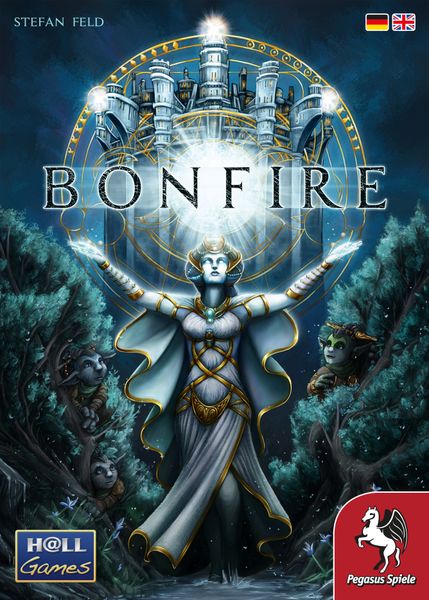
Flash Review — Bonfire


Players: 1-4
Works well with just 2: Yes!
Solo quality: very good
Age: 12+
Playtime: 70-110 min
(but once you know the game, it’s at most 60 min for a 2-player match)

Gnomes and guardians and magical bonfires, plus mystical islands you need to reach by boat…
It’s a fantasy theme wrapped around a tight engine where players need to generate their own Action Tiles (and be clever about it), and then use those tiles to accomplish special tasks, rebuild their cities, rekindle the magic—all the while keeping an eye on dwindling resources.

I don’t care for the theme (which makes the game a bit more difficult to grok than it should be), but the mechanics are fantastic, the components beautiful, and the tension genuine: you always want to do five different things at once. Bonfire is a typical Stefan Feld design, where points come at you from every direction, but which requires some serious optimization if you ever hope to emerge victorious.

Beware, though, that Bonfire is not an entry-level game: while each rule is simple to understand, putting them all together into a coherent strategy can be overwhelming for newcomers, at least in the first couple of games.
But it’s all well worth the effort.

Most easily forgotten rule: You can’t play a Fate Tile if you hold more than 1 Action Tile. (You can discard down to 1 if you want, though.)


# # #

Thursday, January 7, 2021

Flash Review — Clinic (Deluxe Edition)


Players: 1-4
Works well with just 2: Yes!
Solo quality: okay
Age: 8+
Playtime: 120 min

A game about building, running and profiting from your very own medical clinic.
Expand to meet the needs of your patients, hire and/or train doctors to treat specific ailments, and if all else fails, make sure you have enough nurses to pick up the slack!

Clinic is a medium-weight Eurogame that looks much more complicated than it actually is. The first game is difficult, no doubt about it. But once you’re on the other side of the learning curve, the rules are pretty straightforward. Wielding those rules to maximum efficiency—now there’s a real challenge for you. It’s got clever mechanics that make you want to come back just one more time to try and do better...

Really, it’s all about thinking in three dimensions. Same-color modules cannot be adjacent, and that includes vertically. So mind what you plan to build on those upper floors. Also, untreated patients worsen from one turn to the next, so try not to have any of them die on you, because your final score (popularity!) will suffer from it.

The solitaire option is basically a puzzle where you try to achieve a specific goal within the game’s six-turn structure. Since there are several possible goals, you can pick a different one each time, or even let chance make a selection for you.
Far from my favorite solo mechanism, but it works better here than in other games I’ve encountered.

Most easily forgotten rule: Whenever an employee or a patient enters your clinic, you must add one car to your parking spaces! If you can’t park the car, you can’t get the employee or patient.


# # #

Sunday, January 3, 2021

A Year of Boardgaming, 2020 Edition


2020 was a different year in a lot of ways, and boardgames were naturally impacted. In the spring, face-to-face gaming became a thing of the past—outside of family members I could convince to sit down and let go of their screens for an hour or so. 

Still, my boardgame buddies and I managed to keep playing together, partly through digital versions of our beloved games (with tools like BoardGameArena.com or Tabletop Simulator), but also using videoconferencing, which turned out to be our preferred method. As long as we all own a copy of the game and no vital components are meant to be shared, calling out moves and recording them on our respective boards (à la chess by mail) proved not only to work well, but also to be very enjoyable! It means you can get to your "friend's place" in no time at all, and that you also can keep playing until the wee hours, because the minute you turn off your camera, you're home.

Which begs the question: do you count plays of digital boardgames?
I certainly counted plays with physical components over videoconferencing, because I was handling an actual game, no matter what. (Hell, it's the same reason I count solo plays.) However, I decided against counting digital plays, because they're essentially video games.

And with that preamble out of the way, let's take a look at some stats for the god-aweful year of 2020. As I expected, everything pretty much took a nosedive.


GAMES
I played 101 different titles (way down from 135 in 2019), for a total of 384 plays (down by a hundred from 483—and to think that last year I had written, "I'll make and effort and try to reach 500 plays for 2020!"). Interestingly enough, I spent 450 hours poring over mapboards in 2020, and 453 hours in 2019, which means that the games I played last year were bigger and longer than those from 2019. As I wrote above, if you don't have to drive home after a gaming evening, you don't shy away from heavy games that will go the distance.
In any case, that's almost 19 full days devoted to boardgaming bliss. I'm a happy camper.

Out of those 101 titles, 42 were new to me (down from 63 in 2019). That was to be expected: since we were learning a new way to play boardgames—remotely—it made sense to stick to game we already knew. But hey, I can't stay away from new stuff completey, you understand...

Here are the 10 games I played the most in 2020:
1. Wing Leader (40 plays)
        WWII air combat. One of my gaming buddies and really fell in love with that one, and we just couldn't stop playing it: 40 plays, all over videoconferencing. And it's not a quick game, with average sessions lasting about two hours, and some of the more massive scenarios eating up over five hours. 
2. The Quacks of Quedlingburg (30 plays)
        An enchanting push-your-luck/bag builder, and a family classic. 
3. Arkham Horror: The Card Game (18 plays)
        A card-based cooperative game of absolute horror and creeping insanity, with artwork that will both amaze you and keep you up at night.
4. Combat Commander: Europe (14 plays)
        WWII tactical warfare, and my favorite game ever.
        A relatively simple wargame that retraces medieval history. The GF and I played all 12 published scenarios and are eagerly awaiting the first expansion. Bring on the Crusades!
6. Cooper Island (11 plays)
        A tight and clever worker-placement game about developing your chunk of a shared island, and sailing as far as your resources will let you.
7. Thunder Alley (10 plays)
        NASCAR on a cardboard track, and one of my go-to racing games. (But it's getting a run for its money from the new Apocalypse Road, which was one of my favorite games of 2020.)
8. Apocalypse Road (10 plays)
        Speak of the devil... This is Mad Max on a racetrack: drive around the board and shoot everything that moves.
9. Back to the Future: Back in Time (10 plays)
        A heart that beats with clever mechanics and an obvious love of the original material. Perhaps my favorite cooperative game, but the jury's still out.
10. Ottoman Sunset (10 plays)
        A solo WWI game where you try to keep the Ottoman Empire together. Instructive and frustrating in equal measures.

PEOPLE
During 2020, I explored the boardgaming world (mainly from my home) alongside 36 different players, down from 55 in 2019. It's the pandemic: I'm really not turning into a misanthrope. I think.

So here are the 10 people with whom I played the most last year:
1. Suzie D. (137 plays)
2. François P. (108 plays)
3. Jean-Luc S. (60 plays)
4. Ophélie K. L. (32 plays)
5. Gustavo A. (24 plays)
6. Héloïse K. L. (24 plays)
7. Niko S. (15 plays)
8. Fred B. (10 plays)
9. Philippe M. (8 plays)
10. Marilyne E. (6 plays)

The GF is keeping her crown, winning top spot for the fourth consecutive year! (Being trapped with me in the house pretty much sealed that deal back in March.)
I'm delighted to see my two youngest daughters back on the list, and also a handful of colleagues who had just over two months to leave their marks before the pandemic (and a new job) whisked me away.

LOCATIONS
While my boardgaming had brought me to 17 locations in 2019 (including Normandy, France!), I ended up playing games in only 12 different places throughout 2020—essentially 11 different spots in the first three months of the year, and then "home" or "FaceTime" (which I decided to count as an alternate home location) for the next nine months.

80% of my playing was done from the confines of my home, as opposed to 56% in 2019. My workplace boardgaming amounted to barely 5% because, well, it turned into a biohazard wasteland.
Perhaps 2021 will be different in that regard. Perhaps.

RANDOM OBSERVATIONS
My yearly H-index has been 10 for five years in a row. I'm cursed!
(In this context, my H-index is the number (h) of games which I've played a number (h) of times.) In other words, for the past five years, there are 10 games I played 10 times each. Last time I played 11 games 11 times each was in 2014.

I barely accomplished my 10x10 challenge in 2020 (play 10 games 10 times each), so I'll set myself another regular 10x10 challenge for 2021. In addition, I'm also creating a "reach 25 solo plays" challenge, and a "reach next (global) H-index" challenge. So far I've played 35 games 35 times each, which means that my next H-index is 36. We'll see how that goes.

My favorite game, Combat Commander, currently stands at 445 plays. I doubt I'll reach 500 in 2021, but maybe in 2022... My buddy François and I haven't progressed in our project to replay the entire second world war through Combat Commander in quite a few months, but we'll surely get back to it before too long.

I began 2020 with Azul: Summer Pavillion and I ended it with The Quacks of Quedlinburg. Two light games that don't do justice to all the heavy boardgaming that took place between those bookends.

So what am I looking forward to in the coming year?
There's the new edition of Kanban: Automotive Revolution, from designer Vital Lacerda, which promises to be even better than the already stellar first edition. Aliens: Another Glorious Day in the Corps! arrived a few days before Christmas and remains unplayed as of yet, but it won't escape the violence of torn shrinkwrap and punched components for long. The new Stefan Feld game, Bonfire, is already punched and ready to go at the first opportunity. 
Two new GMT titles I was eagerly awaiting—Caesar: Rome vs Gaul and Imperial Struggle—arrived in 2020 but proved too difficult to bring to the table under pandemic conditions; hopefully 2021 will be the year they finally get played. A third game from GMT, Dominant Species: Marine should reach my doorstep in a few weeks, and will hit the table in short order.
And 2021 is the year I'll finally get cozy with two particularly demanding solo games: the veteran Fields of Fire and the new recruit Stellar Horizons. If you hear me swear at an invisible opponent, alone in my basement, that'll be the reason why.


# # #