Showing posts with label flash reviews. Show all posts

Wednesday, July 8, 2026

Flash Review — Attila

Players: 2-4 
Works well with just 2: Yesbut see my houserules
Age: 10+ 
Playtime: 45 minutes
Complexity: 4/10

[An oldie that's still a blast today... Attila was first published back in 2000!]

The dreaded Huns are pushing Germanic tribes to scatter all over Europe, and it's up to you to help them thrive (and eliminate some rivals while they're at it) as they breach the outer reaches of the once-mighty Roman empire.

On your turn, you play a card to add a meeple of that color to a region of the board, then increase your influence over that tribe... or add a second meeple in that color to the same region. As soon as more than four meeples find themselves in a region, a conflict breaks out. Each player gets to play face-down cards that match one (or more!) of the colors involved: total power is tallied for each tribe (number of meeples + number of cards played in that color) and the weakest tribe is eliminated from the region. Then the region is pacified: nobody can play there for the rest of the game. 

The game moves through four eras, each one lasting a little longer than its predecessor and granting players a little more influence whenever they place a meeple on the board. Scoring takes place at the end of each era, for each tribe: the player in 1st place on a tribe's influence track scores 1 point per meeple from that tribe on the board, while the player in 2nd place scores 1 point per region those meeples occupy. After four eras, the game ends and whoever's managed to score the most points is declared winner.

The beauty of the game lies in its simplicity, and it's fascinating to think back to 2000 and realize that, at the turn of the millennium, this was as complicated as most eurogames got. Some of those did not age well (Doge or Vino spring to mind) but Attila sailed through the decades without shedding any of its charm or bite. It's a fast and brutal end-of-the-evening little game, and I can't believe I hadn't played it in a decade. Shame on me.

The game does come with two-player rules but they suck.
So here are my battle-tested houserules for a fun two-handed skirmish:

1. Each player plays one card per turn, per standard multiplayer rules.
2. In order to get points on each tribe's influence track, the second-place player must be within X spaces of the lead player, where X equals the current era (1, 2, 3 or 4).
3. For each conflict, after both players have played their cards, X cards are added to the conflict from the top of the draw pile, where X equals the current era (1, 2, 3 or 4).
4. No action tiles may be played during era 4.

Most easily forgotten rule: I mean, this game is so simple... but if you really need one, don't forget to score points after each era.


# # #

Wednesday, April 1, 2026

Flash Review — Luthier

Players: 1-4 
Works well with just 2: Yes!
Age: 14+ 
Playtime: 90-150 minutes
Complexity: 8/10

You were born to a family of renowned instrument makers in the halcyon days of classical music. And you shall devote your life to the making, maintenance and promotion of your genius creations—as long as generous patrons keep your whole enterprise afloat, it goes without saying.

Over six rounds, players compete for resources, instrument blueprints, repair contracts and performance opportunities, all while advancing their reputations as masters of their craft.

Now do not brush Luthier aside as just another medium-heavy worker placement game. It comes with an exciting twist: each worker is a disc (numbered from 1 through 5) placed face down on the action of your choice. Normally, the owner of the first worker dropped on a location gets first dibs; unless, that is, another worker there is revealed to sport a higher value, in which case workers are switched around. 
So do you really need to use your 5 there? Or will a 3 do the trick, freeing your top worker to exert their influence elsewhere?

The theme is fantastic, superbly well integrated into the game mechanics, and the production is lavish enough to have Stradivari make a double-take. (Even the lowly "retail edition" looks great, with the deluxe version turning the glam up to 11.)
The rulebook might appear daunting, but Luthier's not a complicated game to learn. Playing it well, though? Might be faster to just pick up the cello.

Most easily forgotten rule: A patron's cube resets each time you satisfy one of their requirements.


# # #

Wednesday, November 26, 2025

Flash Review — Eagles in the Sky


Players
Age: 12+ 
Playtime: 15-240 min (for the campaign game!)
Complexity: 8/10

Take to the heavens in your trusty Sopwith Camel and try to get into an advantageous position behind that Fokker DR.I with the red livery... before he does it to you first.

Recent games that model air combat during the Great War are few and far between, which makes Eagles in the Sky all the more inviting. And coming from Revolution Games, the package was too hard to resist.

The game runs on a system of relative positions: there's no map across which aircraft glide and try to find each other. Rather, if you spot an enemy at your altitude (or manage to climb or dive to meet them there), you can play a card whose value gets added to the relevant maneuver rating of your aircraft. And if the opponent can't match that sum, you'll find yourself tailing them and in a position to shoot. Then it's all a matter of better exploiting the enemy's weaknesses so you can improve your position and keep tailing them until you can send their flying machine down in flames. 
But that's assuming they won't manage to shake you off their tail—or worse, turn the tables and start shooting back!

A single engagement (either historical with set parameters, or generated randomly using a series of handy tables) can be over in as few as 15 action-packed minutes. The real jewel, however, is to be found in the campaign system, which strings together five intense days of sorties with a variety of missions: strafing trenches, taking down balloons, bombing enemy positions, the classic patrol, and more.
Be mindful of the weather, track your hardware, repair and replace aircraft, train new pilots, and just pray they survive long enough to get better at the job and—we can only hope—one day turn into aces.

The game is fast and fun, with even campaign games short enough to keep you hungry for more.

Most easily forgotten rule: When you're tailing an aircraft in a climb, you can only attack it using a Climb maneuver card.


# # #

Friday, September 5, 2025

Flash Review — Sail


Players2
Age: 11+ 
Playtime: 20 min
Complexity: 4/10

Cooperative trick-taking games were unheard of just a few years ago, and then The Crew came along to show the world just what we'd been missing.
Sail is another one of those, similar in some ways to Jekyll & Hyde vs Scotland Yard, but this time pitting two partners against the dangers of the high seas.

The game is played with a three-suited card deck and a grid of diamond spaces, where players work together to get their pirate ship to its destination while avoiding the dreaded Kraken. This is accomplished through a series of tricks: one player lays down a card, and the other must follow suit if they can, or else play any card from their hand.

Each card shows a number (from 1 through 9) along with a symbol, and the combination of symbols played by both players determines what happens next. Two steering wheels? Move the ship one space forward, in the direction of the player who won the trick. A wheel/tentacle and a cannon? The ship stays put, but the wheel/tentacle card goes to the Kraken deck (more on this below). Two mermaids? Move the ship forward across the diamond diagonal—that's like two moves in one!
And so on.

Halfway through the learning scenario

Whenever the Kraken would attack the ship (there are multiple cases when this happens), discard a specified number of cards from the Kraken deck. If the Kraken deck ever runs out of cards, the ship sinks and the game is lost.
But make it in one piece to one of the end spaces, and victory is yours!... Until the next scenario, which makes life unavoidably more difficult for the players.

Sail is a real gem of a game, with beautiful art, addictive gameplay and a conveniently small footprint.

Most easily forgotten rule: There's not much to forget here, but how about this—at the end of each round, the Kraken attacks the ship a number of times equal to the value under the Kraken meeple on the Kraken board.


# # #

Tuesday, January 7, 2025

Flash Review — MATRX GIPF


Players
2
Age: 14+ (but it's really more like 8+)
Playtime: 30-60 min
Complexity: 3/10


MATRX GIPF is a two-player abstract game that brings Project GIPF—a celebrated nine-game series launched in 1996 by Belgian designer Kris Burm—to a glorious end.

The game is essentially GIPF, where you're putting pieces in play by pushing them (and everything in their path) from space to space in a straight line. If you succeed in forming a row of four of your own pieces, you return them to your reserve and eliminate any opposing pieces that extend that row.
Much like in GIPF, there are two ways to win: by eliminating your opponent's three basic pieces, or by running your opponent out of pieces in reserve. 
However, unlike GIPF, where all pieces move in the same way, MATRX provides five different types of piecesstacked two-by-twoeach with its own capabilities. So you can use a two-piece stack and make a standard GIPF move (pushing it into play) or you can pick the top piece of a stack and perform that piece's special move.

Learning the rules is a tad more difficult than your standard Project GIPF game, owing to the various piece types. But mastering the strategy? Now that's a different matter.

The result is an abstract symphony that may sound a bit familiar if you've ever played GIPF with its potentials (pieces that linked GIPF to other entries in the series), but opens up a whole new harmony of strategic and tactical possibilities. I'm just a few games in, but I can already see I'll be playing this one for decades to come.

I'd recommend you start with GIPF, but you certainly can't go wrong graduating to MATRX once you're comfortable in those 29-year-old shoes.

Most easily forgotten rule: When using a TAMSK piece, the extra move is considered an extension of the regular move, which means that no piece can be removed from play until the whole regular+extra move has been resolved.


# # #

Saturday, December 14, 2024

Flash Review — Jekyll & Hyde vs Scotland Yard

Players: 2
Age: 10+
Playtime: 20 min
Complexity: 4/10

Jekyll & Hyde vs Scotland Yard, in addition to being a mouthful, is a co-operative trick-taking game that unfolds over 10 brief chapters: you can either link those together to form a campaign, or tackle them individually, in any order you wish.

Each round sees the play of eight tricks, with each trick comprising three cards: one from each player and one from the City deck. You know the drill: follow suit if you can, otherwise anything goes. The first color to hit the table becomes the most powerful suit for that round, while the second color to make an appearance becomes the second most powerful suit—leaving third place for the game’s remaining color.

Each trick is won by whoever (including the City) plays the highest card in the most powerful suit
, and those cards remains in full view for future reference. Clever use of potion cards allows players to manipulate the relative strengths of all three suits, exchange a card with the City deck, or even steal a trick previously won by the City.

When eight tricks have been played (and won), the round is scored: the Jekyll/Hyde pawn moves forward one step on the board for each trick taken by the player who won the fewest tricks, plus one step for each 8-card found in the tricks of each player. But be careful: every 1, 2, or 3 also found in those tricks will move the Scotland Yard pawn forward one step.
Play a second round, and then you and your buddy succeed if Jekyll/Hyde made it home before the police caught up with him.

But it’s not enough to avoid losing. Each chapter presents different ways for players to earn points: win a trick by playing an 8, win the final trick, etc. Tally your score for the whole campaign, and then try to do better.

The game is simple, fast, devilishly clever and addictive.
You should be playing it right now, instead of reading this!

Most easily forgotten rule: Turn order is indicated on the Character token, and moves either clockwise or counterclockwise.


# # #

Tuesday, December 10, 2024

Flash Review — War Story: Occupied France


Players: 1-6 (but see below)
Works well with just 2: Yes but… 
Age: 14+ 
Playtime: 45-60 min 
Complexity: 4/10

As agents of the SOE (Special Operations Executive) at the height of WWII, your job is to infiltrate German-occupied France and link up with the resistance movement there, in order to carry out a string of missions from which there is likely no coming back.

War Story: Occupied France is essentially a solo game that you can play with friends: there are four agents in play at all times, but none of them is assigned to any given player. It’s just a pool or resources that you—and your eventual partners—can use as needed.
It’s also very much built like a choose-your-own-adventure novel, with numbered paragraphs to read, decisions that send you to further paragraphs, and so on. I would go so far as to say that it’s not quite a game: it really is more of an interactive novel, with some light game elements peppered throughout. (If you want an actual hybrid of interactive story & boardgame, This War of Mine delivers in spades.)

But is this interactive story any fun? Yes.
The game runs on very simple rules, making it possible to crack the box open and start playing right there and then; it also comes with three scenarios that throw you deep into occupied France and force you to make difficult decisions from the get-go. You can play each scenario individually or link them up in a three-part campaign. And each scenario is replayable, despite the absence of randomness anywhere in the system.

I would however dock War Story: Occupied France quite a few points because of the sheer number of errors in this first edition of the game. You’ll frustratingly have to spend a while correcting the various paragraphs (and cards…) highlighted in the FAQ before you get going. And we’re not just talking typos (although they do exist: just ask the unfortunate Domonique you’ll encounter in the game): these are wrong paragraph numbers, erroneous instructions, as well as missing icons and various indications. It’s unacceptable; especially from Osprey, a publisher that should know better.

Also, I can’t for the life of me figure out why—much less how—you’d play this with more than two players. Remember, it’s an interactive story: there’s not much to do, even for one person playing this solo. So if a buddy wants to enjoy the ride with you, fine. More than that, and they’ll start asking themselves what they’re doing there.
But SIX players? That’s insanity.

Most easily forgotten rule: You can only spend special tokens when the current paragraph shows the chevrons icon.


# # #

Thursday, November 28, 2024

Flash Review — Bomb Busters


Players
: 2-5
Works well with just 2: Yes!
Age: 10+
Playtime: 30 min
Complexity: 4/10

Bomb Busters requires a team of players to work together to defuse one bomb after the other (after the other). Sure, you’ve got cool gadgets to help you along the way and more than one trick up your sleeve—assuming you’ve got any arms left—but will you manage to keep your cool long enough to avoid triggering that damn thing?

The game is all about cutting (the right) wires, which are represented by narrow cardboard tiles that each show a number between 1 and 12, with four copies of every number. Each player gets a stand where those tiles—distributed at random—are stood up in ascending order, with the wire values facing the owner of the stand. So you know what your wires are, but nothing else. Using a clever system of very limited clues, you may eventually deduce some information about a few of the wires held by your teammates.
Now since wires must be cut in pairs, if you want to cut, say, your 5 wire, you must first cut a 5 wire on someone else’s stand. So when you think you’re sure (...), you point to a specific wire, say “I’m cutting this 5 wire!” with as much confidence as you can muster, and hold your breath. If you’re right, your teammate lays down that wire tile face up in front of their stand (and the position of that revealed tile in your friend’s spread hopefully feeds you with further information you can use) and you do the same with your like-numbered wire.
And if you’re wrong? Boom.
(Okay, each mission allows for a handful of mistakes before everyone gets blown to pieces. That counter goes down fast: don’t get too comfy.)

Oh you thought that was all? That’s so cute.

There are also yellow wires, each numbered as a .1; so you get a 1.1, a 2.1 and so on all the way to 12.1, with a few of them thrown into the mix before tile randomization. The trick here is that yellow wires must also be cut in pairs, meaning you must point to a tile on someone else’s stand, say “I’m cutting this yellow wire!” and hope to God you’re right, so that you can also cut a yellow wire on your own stand.
Red wires? Of course we’ve got red wires, each numbered as a .5: 1.5, 2.5, etc. Those you CANNOT cut at all. And there are no oopsies when you cut whatever circuit was keeping the bomb from embracing entropy.

Each mission consumes at most 30 minutes of your time (sometimes way less, trust me) and the box comes with a whopping 66 increasingly difficult missions for your exploding pleasure.
Plus there's a very nifty twist that makes the game work like a charm with just two players.

If this doesn’t win the Spiel des Jahres for 2025, I’ll eat my bomb suit helmet.

Most easily forgotten rule: If one player has all four copies of a numbered wire on their stand (say, all four 2s), they can do a “solo cut” and reveal them all at once. Same thing if anyone holds the two remaining wires of any one number.


# # #

Thursday, November 14, 2024

Flash Review — Skyrise


Players: 2-4
Works well with just 2: Yes!
Age: 14+
Playtime: 30-90 min
Complexity: 4.5/10

Skyrise is an auction game where three different factors are always at play: currency (what you’re bidding), building (what you’ll put on the board if you win) and location (where you’ll build if you win.)
And wouldn’t you know it? Turns out that in this case, all three of these things are one and the same.

The game is played on a modular board: the more players partake, the larger the playing surface becomes. Each space shows one color and houses a token assigned to it at random. Each player is issued a series of buildings in three sizes, with each building sporting a number on its bottom. One player places a bid, putting a building (upside-down so the number is visible) on a space they want to occupy. The next player can outbid by placing a building with a higher number on an adjacent space, and so on until everyone passes. Then the highest-numbered building gets built on the space where that winning bid was placed, and a new auction starts. When you build a building, you grab the token from that space and add it to your collection; it contributes to the points you’ll score, in one way or another.


The goal here is to accumulate the most points over two scoring rounds—one mid-game and the other at the very end—according to secret and open objectives, plus domination over sections of the board, depending on who’s got the most tall buildings here and there.

The whole thing is over in about 30 minutes, the game looks fantastic (even in its basic wooden-buildings retail edition) and it’s refreshingly different from whatever else you stock your shelves with. (Except maybe Metropolys, the original game Skyrise reimagined.)

Most easily forgotten rule: You can always start a new auction next to a building already on the board or on the central island.


# # #

Tuesday, May 21, 2024

Components flash review — For the People, 25th Anniversary


Players: 2
Age: 14+
Playtime: 360 min
Complexity: 9.5/10

This American Civil War classic—long considered the final table-top word on the conflict—has been around since 1998, and has seen many a reprint in the intervening decades. I joined the party back in 2015 with GMT’s third edition, but it’s already been 10 years and I haven’t played the game nearly enough in all that time.
So why not pick up the musket once more with a new version of For the People hot off the press for its 25th anniversary?

GMT gave the game a visual overhaul by commissioning a new cover from Donal Hegarty, as well as a new (mounted) map from Terry Leeds. The game also ships in a thicker, 3-inch box which allows the neat freaks out there to sleeve their cards and stow their counters in trays while still enjoying the subtle bliss that comes with a wargame box that closes just right. (You can also order just the new box and map, should you be so inclined.)

The new cover depicts Lincoln before a tattered American flag, in a sombre departure from the original GMT artwork. And while there’s no question that the 25th anniversary edition proposes a modern, war–is-hell kind of vibe, I still have a soft spot in my heart for the old-school appeal of its predecessor.

I quite like the new box (and I’ll never say no to more storage) but I’m perplexed at the decision to depict only one side in that conflict. Gone is Jefferson Davis, indeed any allusion to Confederate forces. When I spied Ulysses S. Grant on one of the lateral panels of the new box, I assumed Robert E. Lee was waiting for me on the other side. Nope: turns out it’s Sherman, another Union general.
None of this detracts from the appeal of the new package, mind you; I’m just curious as to the creative decisions behind the work.

I find the new map—now in earthy tones—more functional than the original, with modern trimmings, clearer reminders, and an overall palette that makes units on both sides really pop when strewn across the countryside.

Original map

New map

Units on both maps

Not sure what map you’d favor? Fret no more! The mounted eight-panel board has the original map printed on its sturdy back, for your ambivalent pleasure.

Of course, all known errata have been addressed, and the new version of the full game ships with an updated 2024 rulebook. Completionists might be dismayed at the absence of variant rules and components (published in various issues of C3i Magazine over the years) but they’re not at all necessary: the game itself packs a punch that’ll send you reeling for years, if not decades to come. (I own all of that—including three bonus reminder counters that I picked up at some point—and I have yet to bring that stuff into the game.)

Above all, I’m just happy to see For the People go at it for one more round, fighting for the high ground and a chance to win new wargamer hearts.
That’s what the hobby’s all about.


# # #

Monday, December 18, 2023

Flash Review — Great Western Trail: New Zealand


Players
: 1-4
Works well with just 2: Yes!
Age: 12+
Playtime: 75-150 min
Complexity: 8/10


As a fan of both the original Great Western Trail and its Argentina variation, I had very high expectations when it came to the third and last entry in the series, New Zealand.
Did it live up to its pedigree? Yes and no.

Cattle is replaced by sheep, the workers you pick up on your journey don't exactly behave the way their predecessors did, but overall you're playing GWT. The main differences are as follows:

1. You can shear your sheep (instead of shipping them off), using their wool value to gain cash and eventually victory points.
This addition works really well, introducing the shearer to your roster of workers, and making it possible to 
earn quick cash while you're still on the trail, before you get to Wellington (your shipping-off port in this game).

2. Your train is replaced by a ship that travels to open up new business avenues (similar to the Rails to the North expansion for the original game).
The more sailors you hire, the farther your ship can move; and although you are not required to move your ship, it can provide you with significant benefits you'd be remiss to ignore.

3. Your deck can now be home to a variety of cards that are not sheep, adding a bit more of a deck-building feel to the proceedings.
And it's this change in the rules I'm not convinced I really like. It sure adds variety (the cards are not the same from game to game), but what they actually do is lukewarm at best. Some are sheep (admittedly sheep types you can't get anywhere else, but still), some are objectives (again, exclusive ones, but hey) while others are cards that you play for some resource (gain 1 pound, earn one certificate, etc.) before discarding them and drawing a replacement.
You might see why I'm dubious here: after a handful of plays, I still don't know if those cards bring a vital new mechanic to the game or just add noise to the system, providing resources players could have garnered through other means.

So two excellent gameplay twists, and a third one that leaves me a bit cold.
GWT: New Zealand is still a solid game, but it doesn't feel as refined as its Argentina brother—which to me stands as the pinnacle of the whole series.

Most easily forgotten rule: Contrary to both previous GWT games, you don't have to reveal all of your sheep cards when you reach Wellington. The cards you do reveal all need to be different, but you can hold some of them back if you want.


# # #

Tuesday, November 21, 2023

Flash Review — Tesseract


Players
: 1-4
Works well with just 2: Yes!
Solo quality: fine
Age: 14+
Playtime: 60 min
Complexity: 5/10

A tesseract (a four-dimensional cube) has appeared in the sky, and a bunch of scientists must work together to disarm it before it destroys our universe.

Forget the thin sci-fi conceit: Tesseract is a cooperative game where players slowly dismantle a (three-dimensional) cube made out of dice they then manipulate to perform a variety of tasks. Get the job done before the tesseract finishes counting down, and you win.

Pretty colors can kill you!

The menu of operations available to players is a mix of classic (rotate a die, flip a die, change a die’s color) and innovative (exchange dice with a collaborator, manipulate a die to affect another die remotely, put a die back in the tesseract), all aimed at completing an array of 24 tasks before time runs out.

7 tasks down, 17 to go

The tesseract eliminates at least one of its own dice every turn, and whenever a column is empty, it triggers the base-plate symbol just revealed—and those are no good. Also, if the tesseract ever runs out of dice, the game is lost. But the fascinating thing here is that the raw resources players must use to defuse the ticking time-bomb are the tesseract’s dice themselves. So you have to speed up the timer if you ever hope to stop it. There’s no playing it safe.

That orange symbol removes an additional die from the tesseract. Sorry.

The components are great fun, the lazy susan (gentle!) the tesseract rests on works like a charm, and you do feel the mounting pressure throughout the game. With four different difficulty levels and a gazillion possible starting setups—just look at that cube—the experience should remain challenging for a long time.

Solo gameplay involves a single player going at it two-handed. It’s not my favorite solo system, but it works well.

I’ll just add that the official age suggestion seems out of line here: an interested 10-year-old could certainly play Tesseract without any problem. (Maybe even at 8; kids are sharp.)

Most easily forgotten rule: When you contain a die from the tesseract, you get to destroy an identical die (color and value) from the Primed Area.


# # #


Wednesday, November 15, 2023

Flash Review — Framework


Players: 1-4
Works well with just 2: Yes!
Solo quality: a bit boring
Age: 8+
Playtime: 30 min
Complexity: 3/10

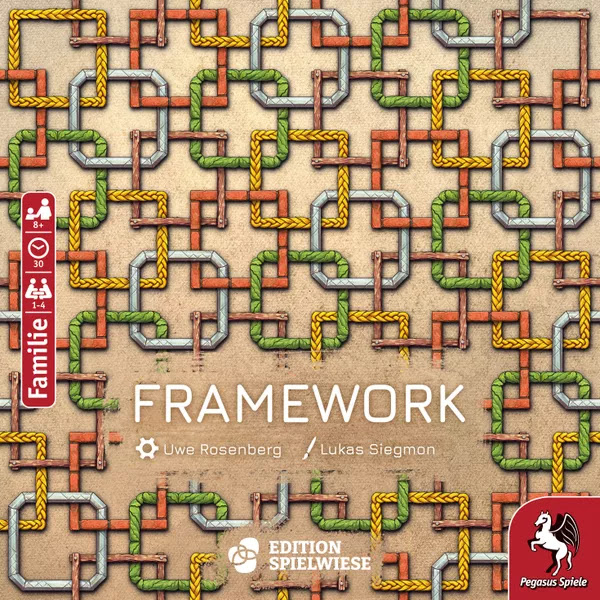
Just like Applejack, this is one of Uwe Rosenberg’s simple-yet-clever designs, albeit under a more abstract guise: you’re just building a series of interlocking tasks that you try to complete.

The game is played with a huge variety of tiles that players organize in rows and columns, with no predefined grid to adhere to. When it’s your turn, you pick one tile from a limited selection on offer and add it to your structure, making sure the new tile orthogonally touches at least one other tile. Then you check if you’ve completed some of your tasks, and put one of your wooden markers on each of them that’s done.

Some tiles will display one or more tasks, in the form of a number on a colored background; other tiles will show one or more colored frames (used to complete the aforementioned tasks); and a third category of tiles will sport both bits of information.

Which would you pick?

To complete a task, you need the required number of frames in the requested color, arrayed in a continuous chain where at least one link in the chain is in direct contact with the task at hand.
In the example below, the 5-yellow task is done (I should put a wooden marker on it), but the 3-gray task is still missing one gray frame
—and the 4-brown/orange task has nothing going for it. Yet.


Some tiles are self-fulfilling (like a 5-green task that also shows a green frame), which makes them easier to pull off and kind of a no-brainer. Where things get twisted (and interesting!) is when you have to deal with, say, a 7-brown task surrounded by a yellow frame: Do you place that tile next to your group of brown frames, or would it be more effective to forsake the 7-brown task and instead use the yellow frame to complete a bunch of yellow tasks elsewhere?

The first player who completes 22 tasks (i.e. runs out of wooden markers) wins the game. And if you’re anything like me, you’ll just want to play it again, and again. It’s amazing how much gameplay Rosenberg can pack in a 30-minute game with two and a half rules to learn, with something addictive thrown in for good measure. So don’t be fazed by the apparent simplicity of Framework: it’s dead easy to learn, yet damn fun to play.

The solo game is, as with most of Rosenberg’s designs, a beat-your-own-score type of puzzle. So the first time you play it, you don’t win nor do you lose: you just set your own benchmark
then you try to do better. Not my kind of solo experience, but it’s over in five minutes and it’s not an unpleasant exercise.

Most easily forgotten rule: In this case it’s not a rule you’re likely to forget, but rather a completed task you’re just not seeing. Keep your eyes peeled!


# # #

Monday, November 6, 2023

Flash Review — Sky Team


Players: 2
Age: 12+
Playtime: 15 min
Complexity: 4.5/10

It’s been an uneventful flight across the ocean, the airport is in sight, and all you and your co-pilot need to do now is safely land that behemoth. Shouldn’t be any problem, right?

Sky Team is a cooperative dice-placement game that, despite its slim 15-minute play time, manages to generate thrills galore throughout and then enthusiastic high fives when the wheels finally touch ground.

Each turn, both pilot and co-pilot roll four dice and assign them one by one (without talking to each other!) to critical systems. Two dice placements are mandatory—engine power and horizontal axis—but you’ll have to take care of the rest eventually. However, will you have the right dice values at hand when you decide to deploy the landing gear, lower the flaps, or apply the breaks? And don’t forget to stay in touch with air traffic control so that they can clear the runway as you start your approach…

The starting scenario, Montreal, uses only the basic functions of the plane, and it’s still a blast to play. As you fly from one airport to the next, new challenges will include fuel management, ice worries, wind problems, further traffic headaches, and even a pesky intern stealing some of your precious time away from vital maneuvers. (And publisher Le Scorpion Masqué keeps adding new, printable scenarios to their website.)

At the very least, it’s worth 15 minutes of your time to give the game a shot.
But I’m convinced YUL love it.

Most easily forgotten rule: Axis and engine power are resolved as soon as their two dice are in place (and not at the end of the turn).


# # #


Tuesday, September 12, 2023

Flash Review — Applejack


Players1-4
Works well with just 2: Absolutely!
Solo quality: Okay
Age: 8+
Playtime: 30-60 min
Complexity: 4/10


Another Uwe Rosenberg game about farming? You bet.
This time we're running an orchard and harvesting apples, using honey as currency.

The game's timer is a die that steps its way around the central board. On your turn, you pick an apple tile from one of the stacks on either side of the die, and add it to your own orchard. Then the die takes one step forward, and it's your neighbor's turn.

Right after the start of the 2nd circuit

If the die passes an apple icon, each player scores that particular apple variety: add up all of your apples of that color displayed on tiles that touch each other in your orchard, and subtract the number on the die (which starts at 1): that's how much honey you earn. There are seven different apple varieties, so pay attention!
When the die has done a complete circuit on the central board, it rotates from 1 to 2 and starts moving again—but this time your apple groups need to be larger to score. After a second complete circuit, the die rotates from 2 to 3, and the game ends halfway through the third and last circuit.
Perform some final scoring shenanigans, and the player with the highest score wins.

My personal orchard, about halfway through a game

If you're familiar with Rosenberg's work, the scope of Applejack can be compared to that of Patchwork. While they don't play the same way at all, both games offer a surprisingly deep decision space, despite shipping with very simple rules and a short playtime. And they're fun!

I've found the game works best with two players: the solo goal is fixed (score 65 points with no one to give you trouble), while multiplayer outings tend to overstay their welcome (60 minutes for a game of Appeljack would test my patience).

Most easily forgotten rule: Flowers do not need to touch when scoring. Just count the number of flowers in your orchard, no matter where they are.


# # #

Wednesday, August 9, 2023

Flash Review — Qawale

Players: 2
Age: 8+
Playtime: 15 min
Complexity: 1/10

Abstract games—with simple rules, even simpler pieces, and zero theme—come and go, most of them rehashing previously attempted concepts with little success. Once in a while, however, a new abstract design just grabs me, and I need to keep playing it.

Qawale couldn't be any simpler. It's played on a 4x4 board with eight dark-colored pieces, eight light-colored pieces, and eight neutral pieces. On your turn, put one of your pieces on top of a pile (which could be just one piece), then pick up the entire pile and move it around orthogonally while dropping the bottom piece on each space you reach, mancala-style.
For example, if you play one of your pieces on a two-piece pile, you'll then pick up the three-piece pile and start moving. Move one step and drop the bottom piece there; move another step and drop the (new) bottom piece there; move a third and final step, and put the only piece you still have in hand there.

You win if you manage to make a row of four (visible) pieces in your color, either orthogonally or diagonally. (In the picture above, the Light player just won.)
If no line exists after both players have run out of pieces, the game is tied.

While it runs on crazy-simple rules, Qawale is full of nuances and surprises. And despite its 16-move limit (8 per player), you can definitely feel an arc to the game: openings, mid-game tactics, and closers.
And what's not to love about wooden boards and playing pieces?

Most easily forgotten rule: Although you can win by making a diagonal line, you can't move diagonally.


# # #

Sunday, July 30, 2023

Flash Review — The Barracks Emperors


Players: 1-4
Works well with just 2: Fine
Solo quality: Puzzle-like
Age: 14+
Playtime: 30-120 min
Complexity: 4.5/10

It's from GMT and it's a large box and there's a big board and it looks serious as all get-out BUT it's a fairly simple trick-taking game, and a fun one at that.
Hear me out.

The goal of this three-round game is to capture as many emperor cards as possible: each is worth 1 point, plus 3 points for each set of three emperors (blue-red-yellow) you manage to assemble.
Random emperor cards start the game already on the board, in the following configuration: 

Only colors matter: text on emperors just historical info

On each round, players take turns playing square-shaped influence cards, which are numbered from 1 through 8 in the three colors mentioned above. A card goes next to an emperor, on the side the player was assigned. So the Sword player can only play on the Sword edge of an emperor card, while the Laurels player can only play on the Laurels edge of an emperor, and so on. But the board layout makes it so that playing to the right of one emperor will also often mean playing to the left of (or above, or below) another emperor.
An emperor is resolved when it's surrounded by four cards: cards of equal value cancel each other out, and among the cards left, the highest value matching the color of the emperor wins (or else the highest-valued card, if none of those left match the emperor's color). The winning card is removed, and the emperor goes to the player whose edge the winning card had been played on. In other words, if the winning card happens to be on the Laurels edge of the emperor being resolved, the emperor goes to the Laurels player—no matter who actually played the card that ended up winning.

Each card also sports a special ability that allows for some funky moves such as flipping another card face down (cancelling it), moving a card away, or adding an emperor to the board. You'll learn them by heart eventually, but I wish GMT had gone with a simple iconography instead of text, as well as a background of a different color for ongoing effects.

Yes, that’s my luggage combination

The cool thing here is that all of a rounds tricks are "available" on the table from the start, so you're playing on multiple ones every time you add a card to the board (because it'll likely touch more than one emperor). The system might prove brain-twisting at first, but give it time and it'll become second nature.

I highly recommend the game at the 3- or 4-player count, but it loses some of its charm with only two—although it's a great way to learn the rules. The solo version feels more like a puzzle than a tactical game, but it works pretty well.

Most easily forgotten rule: Barbarians can deploy AND move only to spaces adjacent to emperors.


# # #

Thursday, December 15, 2022

Flash Review — Weather Machine


Players: 1-4
Works well with just 2: Yes!
Solo quality: [unplayed]
Age: 14+
Playtime: 60-150 min
Complexity: 8.5/10

While Professor Lativ’s wondrous invention is successful in controlling local weather phenomena, the machine also causes extreme “butterfly effect” disruptions elsewhere. There is much to do!

A new game by Vital Lacerda is a yearly cause for celebration within my gaming group. The Lisbon-born (Lisborn?) designer has a knack for coming up with heavy games that play like a massive, well-oiled clock: each element interacts superbly with everything else, and all you need to do is figure out how best to pull the levers at your disposal in order to achieve a resounding success.
Ha.

In Weather Machine, players secure government subsidies, expand their workshops, run experiments using Professor Lativ’s machine, build new prototypes to fix the screw-ups caused by those experiments, publish their findings in academic papers, and build cute little robots to help them do it all. (You can even quote previous papers on the same topic to help get yours published. How about that?)

As you can expect with Lacerda, the design reuses some of his mechanical darlings while injecting novelty in other areas. Overall, the game is not that difficult… but it’s a real challenge to learn, and even worse to teach. (God help me.) Hence my 8.5 complexity rating. All I can say is, don’t give up: the end result is well worth the effort. There’s a special satisfaction to be found in seeing all those intricate mechanics come together and WORK. Plus the little gears (even the cardboard ones—I think the metal upgrades are overkill) are just a joy to play with, and the entire package is gorgeous.

For the Lacerda fans out there, Weather Machine feels to me closest to Kanban out of all his previous designsif that can help push you off the fence.

Sadly I cannot comment on the solitaire module provided with the game, as I have not had a chance to play it yet. But it’s pretty intricate and not for the faint of heart.

Most easily forgotten rule: When you build the prototype (in the R&D department), all of the gears you use must come from the same row in your workshop.


# # #

Wednesday, December 7, 2022

Flash Review — Great Western Trail: Argentina


Players: 1-4
Works well with just 2: Yes!
Solo quality: Good
Age: 12+
Playtime: 75-150 min
Complexity: 8/10

Just a few weeks ago, I wrote a flash review of the excellent second edition of Great Western Trail, the original version of which had earned first prize in my Top 10 for 2016.
Now comes a new setting with slightly modified mechanics, and I’m falling in love all over again.

This time around, you’re driving cattle in Argentina, intent on getting those cows aboard ships bound for Europe. Once again, the board depicts the land players need to traverse on their way to Buenos Aires, with buildings that offer new actions as well as some familiar ones, and farmers instead of bandits. Incidentally, players can help those farmers if they have sufficient strength (a new resource) on their cattle cards and player boards; in return, farmers can be enlisted as workers to help supply the players with grain.

Grain is also a new resource: whereas in GWT you pay money to ship cattle to faraway cities, now you need to pay grain to load them onto ships (placing one of your discs on the ship you selected). At regular intervals, groups of ships depart for Europe, carrying with them player discs they’ll drop in three major ports. From that point on, whenever you’re shipping cows, you can also perform an “extra delivery”—provided you can pay for it in grain—that reuses one of your discs now in Europe, for a juicy bonus in points or pesos.

GWT Argentina is certainly different from its older sibling, but not different enough to warrant owning both versions of the game, unless you’re a GWT maniac. But if you enjoy the original, I can’t imagine you wouldn’t like this new spin on the same robust system. (I just wish the enclosed plastic tray was usable; as it stands you can’t even keep it if you aspire to put everything back in the box at the end of the game.)
The solo module introduces Pedro, a bot with its own cards and little player board who plays against you. Pedro can operate according to three different difficulty settings; either way, you'll soon learn to hate him (in a good way!).

After a few plays, I think Argentina is superior to the classic version, but I’m not ready to get rid of my beloved GWT just yet. What I am ready for, though, is the final title in the trilogy, coming out sometime in 2023—Great Western Trail: New Zealand.

Can’t wait to start herding those wild kiwis. Hee haw!

Most easily forgotten rule: If you have exhaustion cards in your hand when you reach Buenos Aires, you remove them entirely from your deck—you don’t just discard them.


# # #

Thursday, December 1, 2022

Flash Review — Heat: Pedal to the Metal


Players: 1-6
Works well with just 2: Yes!
Solo quality: Outstanding
Age: 10+
Playtime: 30-60 min
Complexity: 5/10

It’s Formula 1 racing in the ‘60s, and you’re at the wheel of a powerful machine barrelling down the speedway. Everywhere you look, the track is filled with brightly colored cars. But hey, what’s one more hairpin turn at breakneck speed?

Heat comes with four different race tracks, six cute little cars and a deck of speed cards for every player, with each card showing a different speed—from 0 all the way to 5. The basic game couldn’t be simpler: shift up or down into the gear you want, play that many cards (from 1 to 4), and move your car as far as it’ll go without getting blocked. If you negotiate a corner during your move, check your speed (total value of the cards you played) against the corner’s speed limit, and pay 1 heat card for each speed increment over that limit.
(You’re rounding a 3-corner at speed 7? That just cost you four heat cards.)

Those heat cards start on your player board and represent your engine’s capabilities to “give a little more.” You begin the game with six, and gradually move them (“spend” them) to your discard pile to move faster or reach a gear you couldn’t normally shift into, in addition to overshooting corners as described above.
You’ll want to rid your deck of heat cards for two reasons: because those become clutter in your hand (possibly causing an overheat situation where your car doesn’t move at all for a turn) but also because if you no longer have heat cards on your player board, you can’t ask your engine for that extra kick you just needed to pass that green bastard on the straightaway. So make sure you shift down to gear 1 or 2 once in a while: those let you discard heat cards back to your player board. (And if you can time that with slowing down for a difficult corner, all the better!)

The game also features a solo mode where the flip of a single card drives all of the pilotless cars (from one to all 6, which means you could just watch the race unfold if you feel particularly lazy one evening). And they’re competitive, too! So much so that there’s no reason not to use a full complement of cars on the track, no matter the number of human players. Even the solo races are proving fun and tense, which is no small achievement.

And there are more options to explore: the garage module (customize your car!), the weather module (you afraid of a little snow at 290 km/h?), and the championship system (one race isn’t the whole story…).

I’m a big racing game fan, and Heat just might make it all the way to the top of my list. It manages to strike a death-defying balance between simplicity, meaningful decisions and excitement, all the while making the whole thing feel like a race. I can’t recommend it enough.

Most easily forgotten rule: You can decide to use adrenaline before or after you boost.


# # #