Showing posts with label abstract games. Show all posts

Monday, December 29, 2025

My Top 10 Boardgames Published in 2025


Here's a look at my 10 favorite games published in 2025.
(Or else made available in North America so late in 2024 that there was no way to really play them before the calendar flipped.)


#10

MATRX GIPF
The culmination of the entire Project GIPF, this ninth entry is more complex than all of its predecessors, without shaving away any of the depth and addictiveness that have been hallmarks of this series of abstract games since 1996. I'll be playing this for years to come, and probably will never get very good at it.
(You can read my flash review here.)


#9

OFF THE LINE
I've never been secretive about my profound and life-altering love of Combat Commander, which always makes me a bit leery of trying out other WWII tactical wargames. But I've got to admit that where several others have floundered, Off the Line managed to hook me, and hook me good. It's the most original tactical system I've encountered thus far, and has forced me to relearn many systems I thought I was done digesting a long time ago. And I mean that in a good way.
It won't dislodge CC in my heart, but what could?


#8

VANTAGE
Now this cooperative contraption is not going to be for everyone, and that's fine. With loosely stated win/loss conditions, it might go so far as to defy the very definition of a game and cross into "experience" territory. You're exploring an alien planet, every session will be different, and you pretty much decide when the game is over. Just jump in and go where the river takes you; I promise it'll be intriguing.


#7

FIELDS OF FIRE - DELUXE EDITION
Yeah yeah yeah, the original dates back to almost 20 years ago—I care not! This deluxe edition was published in 2025 and it bulldozed everything that came before: easier to learn, easier to play, and snazzier than ever. It's still a beast of a game to get into, don't get me wrong. But GMT has done everything in their power to open the door as wide as possible while you ease yourself in. Feel like jumping into solo tactical WWII action with more material than you can shake a whole platoon of sticks at, and more expansions on the way? Look no further.
(You can read my components review here.)


#6

SPEAKEASY
Despite designer Vital Lacerda not topping this Top Ten list like he did back in 2020, he's still making a strong showing with his latest opus, about profiting from illegal booze during the US prohibition. Speakeasy is a heavy game that's somehow more approachable than many of its brethren, in no small part thanks to an engaging theme that facilitates both learning and remembering the many rules found herein. (It also doesn't make the life of the rules explainer an absolute hell the way Weather Machine did...)


#5

TAKE TIME
Partners sit around a clock face showing special instructions and restrictions, and must silently play their cards (most of them face down) around said clock so that when revealed, the sum of the cards in each sector keeps going up all around the clock. One mishap and you start over; but victory allows you to move on to the next clock, where all new challenges and brain rewiring schemes await.
The superstar cooperative game I had on last year's Top Ten list was Bomb Busters (at number 2!) and it went on to win the Spiel des Jahres (game of the year) award in Germany. Will similar honors be lavished onto Take Time in 2026? I wouldn't be surprised.


#4

FIGHTING FORMATIONS - US 29th INFANTRY DIVISION
This new entry in the Fighting Formations series gives you more of everything you loved about the original, this time bringing the searchlight to shine on the exploits of a specific American division. Driven by the now classic initiative matrix —quite useful for barking orders all around in an organized manner—the game proposes a trove of scenarios of the small and large and holy-crap-this'll-take-all-night varieties, which makes it an ideal entry point for any newcomer.
(You can read my review here.)


#3

SETI
Scan the skies, launch probes, develop your technology and analyze all of the data you've gathered—and once you get in touch with actual aliens (because you will), make the best of what you manage to learn from our new friends.
Seti is one of those so-called Eurogames that sit right on the fence between heavy fare and gateway game; it's a challenging engine you can teach in a very reasonable amount of time, and even though your typical game will last around two hours, it won't feel like two hours. And that rotating solar system is just brilliant.
Whether you end up winning or losing, Seti makes it super engaging just to pull its lever and watch it go, and it certainly gets my vote for next year's Kennerspiel des Jahres (expert game of the year) in Germany.


#2

STAR TREK - CAPTAIN'S CHAIR
I was already a fan of the first few titles (known under the name Imperium) that use this civ-ish deckbuilding engine, but Captain's Chair takes everything to a new level. True, it is a more complex game, but it puts nothing out of reach of the average gamer. And it infuses the proceedings with more interaction between players than its older brothers ever provided.
I would go so far as calling it the best Star Trek game I've ever played while at the same time maintaining that you don't need to be a trekkie at all to thoroughly enjoy Captain's Chair. Just sit in it and see if you want to get up again.


#1

CIVOLUTION
There's always a smattering of Stefan Feld designs to be found around my blog, and this year is no different. Still, I've never encountered a Feld game quite like Civolution.
Players are superior intelligences more or less attempting to raise new civilizations in a lab. With more options at your fingertips—and enough stuff spilling out of the box to send you running to IKEA to buy an extra table or two—the game looks like it'll be impossible to digest. On the contrary, it's one of the most organic learning experiences you'll have encountered all year, and it's pure joy to see that engine run. Learn as you go, enjoy the discovery, and thank the graphic designers who came up with visuals that make everything crystal clear!


* * *

DISAPPOINTMENTS
I define disappointments as games I expected a lot from, and which failed to deliver. 
Here are the "top" three from 2024.


Martin Wallace has long been a favorite designer of mine, but his output has equally long been a hit-or-miss affair. And Aeterna sits unequivocally on the miss side of the line. The system is fine, I guess? But it's just that: a system. One that's looking for a game but also, more importantly, for a soul. And there's nary to be found here.

I'm always looking for THE pirate game that'll feel like it was designed just for me, and this one certainly is not that. Oh it's got heart and theme aplenty! It's just lacking everything else, especially meaningful player decisions. It's not because you're rolling dice on a thousand different tables that you're playing a game.
Look at it this way: If this were a computer game, the close-to-nil level of human input required to keep the thing moving forward would have people screaming bloody murder.


Is it an LOTR game? Sure. Is it a cooperative trick-taking thing? I am compelled to answer in the affirmative. Does it do anything that The Crew doesn't accomplish way, way better? Er, no. (Especially The Crew: Mission Deep Sea—just go play that and don't look back.)
This is just an inferior design that sells because it's got LOTR slapped all over it. Don't fall for the shiny trap.

* * *

STRAGGLERS
Let's end on a high note with three games that would have made my Top Ten had I encountered them back in the year when they were published.


With the Fischer-Spassky Championship for a backdrop, this little gem pulls a miniature Twilight Struggle of an engine to get your pulse racing in 30 minutes, no chess knowledge required. I can't believe it took me two years to get around to playing it.


There's something impressive about designing a two-player shedding game with minimal components and a core system that's so simple you can explain it in one sentence, and yet so deep your brain won't fully grasp its implications until you've played at least a few hands.
I was completely blown away by this.


Another cooperative game? 'Tis the season, it seems. This one has you and your favorite buccaneer trick-taking your way through treacherous waters, dry-as-bone islands, maelstroms and the actual kraken! With its magnificent components and clever mechanics, Sail will go a long way towards tempting me to dive into the legacy version that I hear is coming out in 2026.


# # #

Tuesday, January 7, 2025

Flash Review — MATRX GIPF


Players
2
Age: 14+ (but it's really more like 8+)
Playtime: 30-60 min
Complexity: 3/10


MATRX GIPF is a two-player abstract game that brings Project GIPF—a celebrated nine-game series launched in 1996 by Belgian designer Kris Burm—to a glorious end.

The game is essentially GIPF, where you're putting pieces in play by pushing them (and everything in their path) from space to space in a straight line. If you succeed in forming a row of four of your own pieces, you return them to your reserve and eliminate any opposing pieces that extend that row.
Much like in GIPF, there are two ways to win: by eliminating your opponent's three basic pieces, or by running your opponent out of pieces in reserve. 
However, unlike GIPF, where all pieces move in the same way, MATRX provides five different types of piecesstacked two-by-twoeach with its own capabilities. So you can use a two-piece stack and make a standard GIPF move (pushing it into play) or you can pick the top piece of a stack and perform that piece's special move.

Learning the rules is a tad more difficult than your standard Project GIPF game, owing to the various piece types. But mastering the strategy? Now that's a different matter.

The result is an abstract symphony that may sound a bit familiar if you've ever played GIPF with its potentials (pieces that linked GIPF to other entries in the series), but opens up a whole new harmony of strategic and tactical possibilities. I'm just a few games in, but I can already see I'll be playing this one for decades to come.

I'd recommend you start with GIPF, but you certainly can't go wrong graduating to MATRX once you're comfortable in those 29-year-old shoes.

Most easily forgotten rule: When using a TAMSK piece, the extra move is considered an extension of the regular move, which means that no piece can be removed from play until the whole regular+extra move has been resolved.


# # #

Wednesday, December 18, 2024

My Top 10 Boardgames Published in 2024


Here's a look at my 10 favorite games published in 2024.
(Or else made available in North America so late in 2023 that there was no way to really play them before the calendar flipped.)


#10

RED DUST REBELLION
I've just scratched the surface here, but I already like (a lot!) what I see. Yes, this is another COIN game from GMT—volume 12, if you can believe that—but this one being fictitious makes possible a host of things we haven't seen elsewhere. From truly asymmetric factions (The Church of the Reclaimer is a blast—and a brain twister—to play) to semi-random storms that'll hit your forces hard unless they head for cover, this is a brave new world for the COIN series.


#9

JEKYLL & HYDE VS SCOTLAND YARD
Before The Crew, nobody thought a co-operative trick-taking game was possible; nowadays, it seems there's a new one every other month. Jekyll & Hyde vs Scotland Yard is a two-player game to boot, and a damn clever one, where players try to manipulate the number of tricks they win so that Jekyll/Hyde makes it home before the police can catch him. Rotating trump suits and the occasional potion will keep players on their toes—almost as much as the title character.
(You can read my flash review here.)


#8

ALTERED
I thought I had weaned myself off collectable card games back in the day, and this year I tried two new games that confirmed those feelings: Star Wars Unlimited (yawn) and Lorcana (visually superb but mechanically generic). Then I gave Altered a shot and ended up purchasing two booster boxes. It runs on very innovative gameplay, killer visuals, and nothing short of a revolutionary publishing plan. I'm very much looking forward to what's on the horizon.


#7

DUCTH RESISTANCE: ORANGE SHALL OVERCOME!
Orange is a solo/co-op game of resistance in the Netherlands during World War II. Several scenarios require players to dodge German checkpoints, smuggle supplies (even people!) into dangerous locations, and resort to violence when there's no other way. An impressive system and overall package, and from a first-time designer, no less.


#6

SKYRISE
A cutthroat bidding game about building a city in the sky, with simple rules that pave the way for tense and rewarding gameplay. I played the game this was based on—Metropolys—once, years ago; I never felt the need to play it again. But Skyrise elevates (ha!) the action and makes everything shine.
And while there's no denying the deluxe version is seriously overproduced, it does look great on the table.
(You can read my flash review here.)

#5

WOLFPACK
I tried a few submarine games over the years, but they were either too convoluted or else too much "on rails" with few player decisions and an experience that felt more like watching the game happen around me.
Wolfpack hits the sweet spot: Despite the game's 76 pages of (generously illustrated) rules, it's easy to get into a routine of going out on patrols, spotting juicy merchant ships, arming and firing torpedoes... and also evading escorts, dealing with crew injuries, putting out sub fires, fending off flooding and performing a dance of death with depth charges on a daily basis.
What's not to like?


#4

NORMAN CONQUESTS
Not only did this fifth volume in the Men of Iron series convince me to take the plunge, but I enjoyed it so much that I promptly tracked down the first four volumes and am eagerly awaiting #6. The game offers tactical medieval battles with just the right amount of chrome to give you something satisfying to bite into while never overstaying its welcome. 
Just make sure you leave your units room to retreat. You'll thank me later.


#3

OXONO
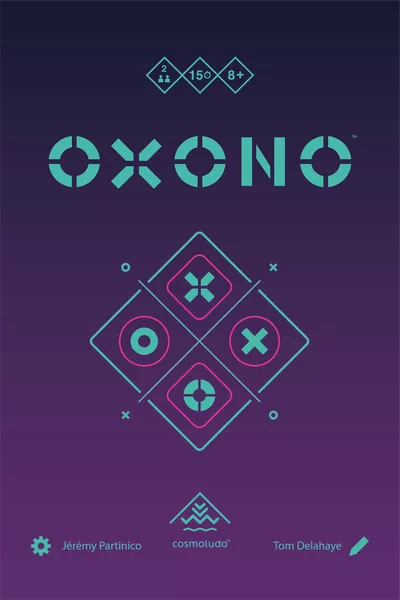
One of those abstract two-player games with minimal components, a cerebral look, and that ubiquitous "place four pieces in a row" victory condition, Oxono almost looks like a toy. Until you play (and lose) your first game, that is. Players move an X and an O totem, both acting as poles around which you can play a corresponding piece (X or O) in your color. It's those pieces you're trying to align, in any colors. So you win if you put the fourth X in a row/column of Xs, or the fourth O in a row/column of Os, no matter who placed the first three; you can also win by scoring a row/column entirely in your color, whatever symbols end up in there.
You can't imagine how challenging—and addictive—that is until you've tried it.


#2

BOMB BUSTERS
This is one of those rare cooperative games where the alpha player problem (running everyone like puppets in an otherwise solo game) cannot happen, because the whole thing revolves around secret information everyone is trying to deduce from the occasional clues put up by their partners. Your bomb squad needs to defuse bomb after bomb by cutting pairs of like-numbered wires: one facing one of your friends (and whose value you're not always sure of) and one facing you. 
And whatever you do, DONT' CUT THE RED WIRE!
(You can read my flash review here.)


#1

DOWNFALL
Last year's #1 entry (Mr. President) began thusly: "The most complex and longest game on the list..." And I'm forced to recognize that it's also the case this year. I might have to seek treatment.
Downfall is kind of a monster game that eats up an entire table (or two) and whose short scenario lasts six hours. Hey, playing the last act of WWII ain't a walk in the park! But the game flows so wonderfully and without any downtime that I find myself transfixed, for however long the whole thing takes.
It is a stunning design that I can't wait to play again.
(You can read my review here.)

* * *

DISAPPOINTMENTS
I define disappointments as games I expected a lot from, and which failed to deliver. 
Here are the "top" three from 2024.


I rarely post negative reviews of games on this blog (life's too short!) but my feelings were so negative in the case of Heat's first expansion that I couldn't do otherwise. (So here it is.) I wasn't disappointed: I was thoroughly pissed off.
In short, I thought they did everything completely wrong, making Heavy Rain the worst expansion I've come across in 30 years of boardgaming. It almost deserves an award just for that.


This one is kind of a mild disappointment, in that I expected great things from this narrative game, and in the end only got "things" that were more often than not on the right side of fun without really making me feel like I'd need to replay the campaign, or get my hands on eventual sequels. Fun enough to borrow from a friend and try once, I guess, but that's pretty much it.


I think it's the first time a game from GMT ends up in this section of my yearly Top 10, and it breaks my heart. I had high hopes for I, Napoleon, but the decision space ended up being way too narrow for my taste. And I really wish there were just one or two lines of historical text at the bottom of each card, so that I could at least learn a few things if I'm not actively choosing stuff.
A pity.
* * *

STRAGGLERS
Let's end on a high note with three games that would have made my Top 10 had I encountered them back in the year when they were published.


Scout is the second trick-taking game on the list this year, and deservedly so. It's a clever, twisted and fun little bundle of joyyou should see that diminutive boxyou can carry anywhere, that plays great with any number of players (including two!) and that will surprise and entertain anyone you ensnare with it.


Two abstract games on the same list might be a first, but I won't shy away from my admiration of this as-clever-as-it-is simple (and elegant) little game. Move a piece according to the pattern highlighted on one of your three cards, then give that card to your opponent. THAT'S IT. And since there are oodles of different cards (did I mention expansions?), no two games are ever alike.

Mandala is one of those games that feels so classic, so elemental, that you can't help but think the design already existed as a traditional thing played by generations past. Right? Nope: made up by two guys a few years ago.
But no matter how (not) old the game is, it's a splendid example of a simple system yielding remarkable depth. 


# # #

Tuesday, November 21, 2023

Flash Review — Tesseract


Players
: 1-4
Works well with just 2: Yes!
Solo quality: fine
Age: 14+
Playtime: 60 min
Complexity: 5/10

A tesseract (a four-dimensional cube) has appeared in the sky, and a bunch of scientists must work together to disarm it before it destroys our universe.

Forget the thin sci-fi conceit: Tesseract is a cooperative game where players slowly dismantle a (three-dimensional) cube made out of dice they then manipulate to perform a variety of tasks. Get the job done before the tesseract finishes counting down, and you win.

Pretty colors can kill you!

The menu of operations available to players is a mix of classic (rotate a die, flip a die, change a die’s color) and innovative (exchange dice with a collaborator, manipulate a die to affect another die remotely, put a die back in the tesseract), all aimed at completing an array of 24 tasks before time runs out.

7 tasks down, 17 to go

The tesseract eliminates at least one of its own dice every turn, and whenever a column is empty, it triggers the base-plate symbol just revealed—and those are no good. Also, if the tesseract ever runs out of dice, the game is lost. But the fascinating thing here is that the raw resources players must use to defuse the ticking time-bomb are the tesseract’s dice themselves. So you have to speed up the timer if you ever hope to stop it. There’s no playing it safe.

That orange symbol removes an additional die from the tesseract. Sorry.

The components are great fun, the lazy susan (gentle!) the tesseract rests on works like a charm, and you do feel the mounting pressure throughout the game. With four different difficulty levels and a gazillion possible starting setups—just look at that cube—the experience should remain challenging for a long time.

Solo gameplay involves a single player going at it two-handed. It’s not my favorite solo system, but it works well.

I’ll just add that the official age suggestion seems out of line here: an interested 10-year-old could certainly play Tesseract without any problem. (Maybe even at 8; kids are sharp.)

Most easily forgotten rule: When you contain a die from the tesseract, you get to destroy an identical die (color and value) from the Primed Area.


# # #


Wednesday, November 15, 2023

Flash Review — Framework


Players: 1-4
Works well with just 2: Yes!
Solo quality: a bit boring
Age: 8+
Playtime: 30 min
Complexity: 3/10

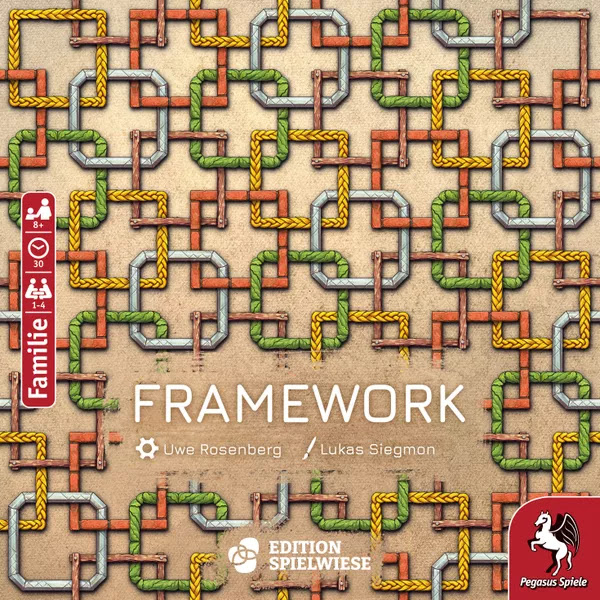
Just like Applejack, this is one of Uwe Rosenberg’s simple-yet-clever designs, albeit under a more abstract guise: you’re just building a series of interlocking tasks that you try to complete.

The game is played with a huge variety of tiles that players organize in rows and columns, with no predefined grid to adhere to. When it’s your turn, you pick one tile from a limited selection on offer and add it to your structure, making sure the new tile orthogonally touches at least one other tile. Then you check if you’ve completed some of your tasks, and put one of your wooden markers on each of them that’s done.

Some tiles will display one or more tasks, in the form of a number on a colored background; other tiles will show one or more colored frames (used to complete the aforementioned tasks); and a third category of tiles will sport both bits of information.

Which would you pick?

To complete a task, you need the required number of frames in the requested color, arrayed in a continuous chain where at least one link in the chain is in direct contact with the task at hand.
In the example below, the 5-yellow task is done (I should put a wooden marker on it), but the 3-gray task is still missing one gray frame
—and the 4-brown/orange task has nothing going for it. Yet.


Some tiles are self-fulfilling (like a 5-green task that also shows a green frame), which makes them easier to pull off and kind of a no-brainer. Where things get twisted (and interesting!) is when you have to deal with, say, a 7-brown task surrounded by a yellow frame: Do you place that tile next to your group of brown frames, or would it be more effective to forsake the 7-brown task and instead use the yellow frame to complete a bunch of yellow tasks elsewhere?

The first player who completes 22 tasks (i.e. runs out of wooden markers) wins the game. And if you’re anything like me, you’ll just want to play it again, and again. It’s amazing how much gameplay Rosenberg can pack in a 30-minute game with two and a half rules to learn, with something addictive thrown in for good measure. So don’t be fazed by the apparent simplicity of Framework: it’s dead easy to learn, yet damn fun to play.

The solo game is, as with most of Rosenberg’s designs, a beat-your-own-score type of puzzle. So the first time you play it, you don’t win nor do you lose: you just set your own benchmark
then you try to do better. Not my kind of solo experience, but it’s over in five minutes and it’s not an unpleasant exercise.

Most easily forgotten rule: In this case it’s not a rule you’re likely to forget, but rather a completed task you’re just not seeing. Keep your eyes peeled!


# # #

Wednesday, August 9, 2023

Flash Review — Qawale

Players: 2
Age: 8+
Playtime: 15 min
Complexity: 1/10

Abstract games—with simple rules, even simpler pieces, and zero theme—come and go, most of them rehashing previously attempted concepts with little success. Once in a while, however, a new abstract design just grabs me, and I need to keep playing it.

Qawale couldn't be any simpler. It's played on a 4x4 board with eight dark-colored pieces, eight light-colored pieces, and eight neutral pieces. On your turn, put one of your pieces on top of a pile (which could be just one piece), then pick up the entire pile and move it around orthogonally while dropping the bottom piece on each space you reach, mancala-style.
For example, if you play one of your pieces on a two-piece pile, you'll then pick up the three-piece pile and start moving. Move one step and drop the bottom piece there; move another step and drop the (new) bottom piece there; move a third and final step, and put the only piece you still have in hand there.

You win if you manage to make a row of four (visible) pieces in your color, either orthogonally or diagonally. (In the picture above, the Light player just won.)
If no line exists after both players have run out of pieces, the game is tied.

While it runs on crazy-simple rules, Qawale is full of nuances and surprises. And despite its 16-move limit (8 per player), you can definitely feel an arc to the game: openings, mid-game tactics, and closers.
And what's not to love about wooden boards and playing pieces?

Most easily forgotten rule: Although you can win by making a diagonal line, you can't move diagonally.


# # #

Tuesday, December 22, 2020

Flash Review — Patchwork


Player count: 2
Age: 8+
Playtime: 15-30 min

A game about putting together a quilt.
(I’m not kidding, and it’s brilliant.)

Move the shared worker around the play area, grab a piece within his range that matches what you need in terms of size and shape, pay the cost (in buttons!) and incorporate that piece into your quilt.

After years of giving us heavy titles such as Agricola, Fields of Arle or A Feast for Odin (all great games, by the way), designer Uwe Rosenberg went back to his roots and came up with a simple, clever and fun game that’s amazingly deep for a 15-to-30-minute experience.

Patchwork was originally published in 2014, and has since then spawned a whole series of variations. Some differ in look only (such as the Christmas Edition) while others feature altered gameplay (like Patchwork Express, if 15 minutes really is too long for you, or Patchwork Doodle, where you write on the board).

I say stick to the original gem of a design, and you’ll find yourself jonesing for buttons again and again.

Most easily forgotten rule: The first player to build a 7x7 square on his board gets the 7-button bonus tile.


# # #