A
bit of backstory.
Ever
since Thunder Alley (the first title
in the series) came out, I’ve been teaching the game to a wide variety of
players, in personal gaming events and at conventions. I even ran a year-long
season at work! And while everyone enjoyed themselves, at least one person—it
never failed—asked me at the end of the race, “Is there a version of this game
with guns?” People just wanted to zoom around the track while shooting up the
competition. And now they can.
The
third entry in the ever-growing Thunderverse (after Thunder Alley and Grand Prix),
Apocalypse Road is played on a large
racetrack that can accommodate up to 10 players. Each track features tight
curves, bottlenecks, a rough section through which no lane change is allowed,
and an even rougher Jump area where cars risk getting more damaged than usual.
 |
Britain's very own Andover Autodrome
|
Players
control a stable of 10 cars each, four or five of which are active on the track
at any given time, depending on the number of players involved. Each car sports
its own speed rating (between 4 and 8) and one weapon type (out of three)
facing forward, backward, or mounted on a turret. On his turn, a player gets to
play a Race card and drive one of his hitherto unmoved cars: the number of
spaces moved is arrived at by adding the automobile’s speed to the card’s
value.
 |
A sample of Race cards
|
Movement
cards come in five types, most of them simulating the effects of drafting. Lead
movement pulls the column of vehicles behind the active car; both Solo movement
and Pursuit movement push the column of vehicles ahead of the active car (with
subtle differences between the two); Line movement takes vehicles in front of and behind the active car along for the
ride; Overtake movement allows the active car to switch places with vehicles it
encounters; and Ramming movement causes a collision when the active car catches
up with a juicy target.
Combat
is fast and simple, and an active car can shoot at an opponent before or after
its move. The player declares an adjacent target in the active vehicle’s arc of
fire and flips the top card of the Combat deck. If the targeting number shown
there is equal to or greater than the car’s defense number, the target is hit
and incurs as many damage markers as displayed above the weapon that just
fired.
 |
| A smattering of Combat cards |
Any
automobile that accrues six damage markers is removed from the race and
replaced with a fresh car from the same team. No more cars available? That
player finishes the race with whatever vehicles remain on the track. (No
worries: when that happens, the race is almost over anyway.)
Once
all cars have been activated—they’re flipped over to signal they have moved—the
round is over. Players are left with one or two movement cards, which they can
either retain or discard, according to what they perceive might be useful to
them once the action starts up again. Everyone then draws back up to six cards,
the 1st Player marker goes to the player with the most damaged cars
(give the kid a break), and a new round gets underway.
Vehicles
keep going around the track with no specific number of laps to complete. A
player scores one point for each of his cars that completes a lap, and
one point for each enemy car he destroys, taking them from a pool of point
markers in the color of his team. As soon as one player reaches 15 points, the
game ends immediately and that player wins.
RULES
OF ENGAGEMENT
Twelve
pages of rule are all that’s needed to fire up Apocalypse Road, and that’s even counting the page about Thunder Alley and Grand Prix integration: you can play either of the three games on
any track in the whole system, with minimal adjustments.
The
game mechanics are straightforward and effective, and can easily be taught in
about 10 minutes. (Five, if your pupils have already played one of the previous
games in the series.) Movement represents the biggest chunk of rules to chew,
with combat a short-and-sweet dessert. Maybe too much so for some people—keep in
mind this is no Car Wars clone, but
rather an exciting racing game with a layer of weaponry thrown on top.
Some
of the rules are not all that clear (do you need a targeting check for a
collision attack?) and one or two others are missing (how do you handle the
dotted spaces on the Essendarium track?), but overall you’ll find what you need
in there, with plenty of examples to drive the points home.
The
Countdown Clock rule is the only one that feels out of place. It requires every
round to end with the removal of one VP marker from each team’s pool of
yet-to-be-won VPs (to speed up the game), and it’s stuck to the back of the
rulebook, under Winning, instead of being part of the End-of-Turn Sequence on
page 4. It’s also missing from the turn sequence printed on the tracks
themselves, and is sure to become Apocalypse
Road’s most easily forgotten rule.
FUN
FACTOR
I’ve
been expecting Apocalypse Road for a
long time: my fellow racers and I started wishing for a mounted-weapon version
of Thunder Alley back in 2014, when
that first game was published.
And
I must say that Apocalypse Road did
not disappoint in the slightest.
The
game is still very much a racing game,
in that the surest and fastest way to score points is to have your vehicles complete a lap as fast (and as often) as you can. But the addition of
gunplay gives rise to some interesting side tactics and epic twists, especially
since you never know how much damage you’ll deal the car you’re attacking. Will
you barely dent a fender, blast the car to smoking bits, or else miss entirely?
I was once robbed of a victory—one space away from claiming my last point!—when
my daughter Héloïse rear-ended another car in a Hail Mary collision attack…
which destroyed the target and gave her
the last point she needed to win.
Some
of the fastest Race cards sport a burst icon that requires flipping the top
card of the Movement Event deck to see what manner of misfortune has been
unleashed. Most of the time it will affect the active card: after all, you know
you’re pushing your vehicle to its limits when you race it that fast. But some
events will target other cars—or even give you an unexpected boost! It’s great
fun and adds just the right amount of tension to a crazy move that drags a
dozen roaring cars clear across half the track.
The
Jump section of each racetrack adds another fun wrinkle. It’s a really rough
patch of road where you don’t want to leave your cars for too long, because
many of the Movement Events target vehicles specifically in that chunk of
spaces. The last thing you want is for your star racer to end up with a busted
transmission.
There’s
also a crossover in the center of the figure-8 track called the Essendarium,
and while it looks super exciting, it turns out to be somewhat of a letdown.
The only thing that happens when cars meet at the crossing is that they each
get one damage marker. That’s it. No spectacular collision, no special rule for
pushing cars back in the loop they just came out of, nothing of the sort. It’s
not a big deal, but it feels like a missed opportunity. House rules will abound
here, no doubt about it.
WAR
PRODUCTION
Apocalypse Road ships with
four large, mounted racetracks. Whereas the tracks in the series’ two preceding
titles were fine but a little drab, the new tracks look exciting, dangerous and
strangely inviting. The game is also equipped with three card decks (Race,
Combat and Movement Events), 10 teams of 10 cars, players boards for everyone
and an assortment of markers to track points, damage, and a few unfortunate
situations vehicles will encounter throughout the race (such as spinning out or
running out of ammo).
Now
as much as I love Apocalypse Road, I
have to point out a few production shortcomings that I feel might curtail the
game’s mass appeal. Some of those problems might stop casual players from
giving Apocalypse Road a shot, and
that would be a real shame.
- Car tokens flip the wrong way, on the short edge
instead of the long one. Flipping cars on the long edge is how it’s done
in both Thunder Alley and Grand Prix, and it is indeed the
natural way every new player will flip cars.
- Some of the teams have their car colors too close
to each other. Especially the two green teams, where confusion on the
track becomes inevitable.
 |
Number 67 belongs to the green team on the right
|
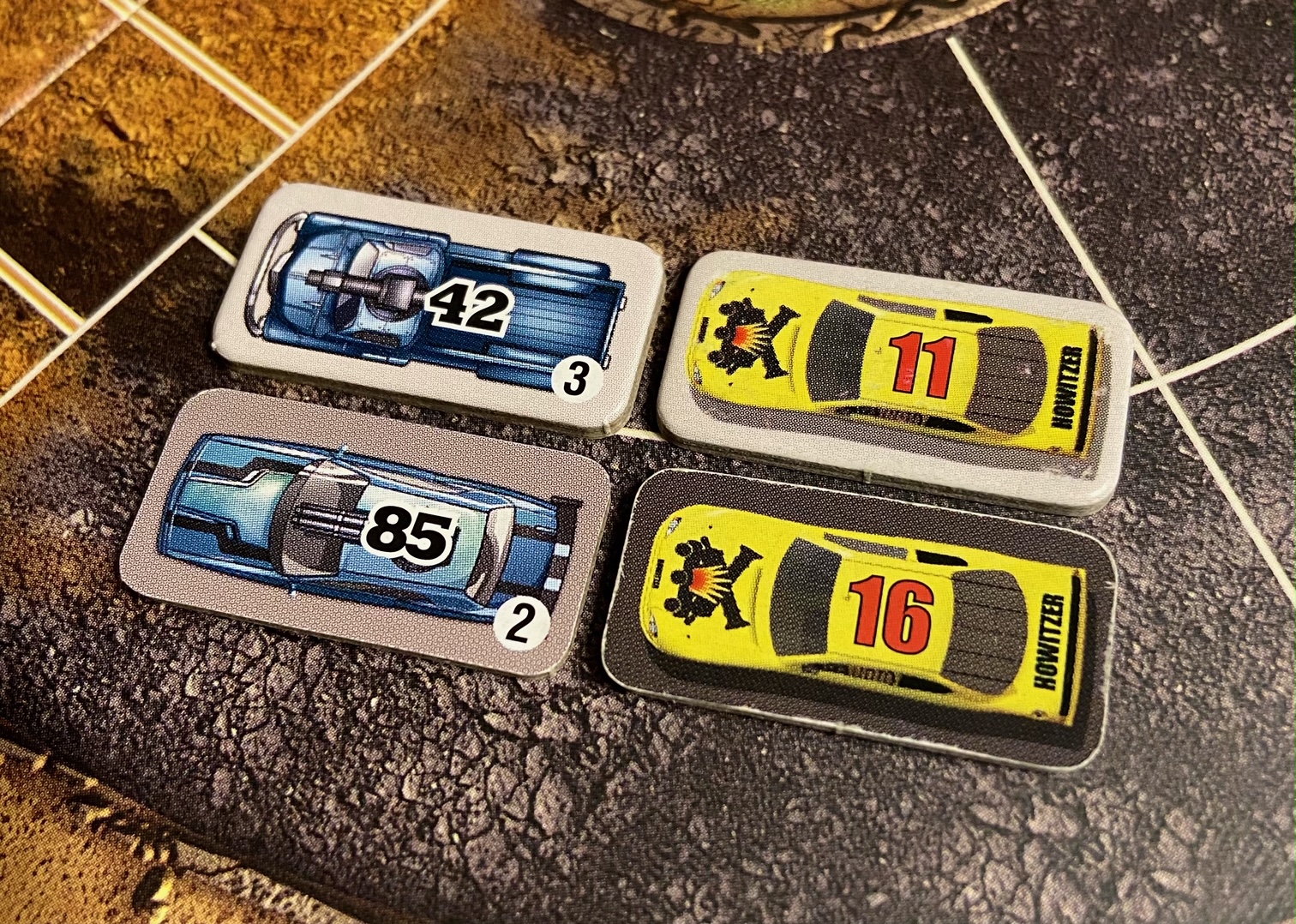
- The car fronts have a light background, while the
car backs have a dark background: that’s how you can tell which cars have
moved and which have yet to act. In Thunder
Alley, the two sides were very distinct. In Grand Prix, the dark side was just a somewhat
darker shade of tan; anything less than ideal lighting made identifying
the flipped cars a daunting proposition. Unfortunately, GMT went back
to that same shade for Apocalypse
Road, and it’s making things more difficult than they need to be. The
really strange thing is that the 1st Player marker, which you
flip back and forth between turns to indicate what side of the cars will
stand for “not yet moved,” has a truly dark side, which is not at all like
the dark color selected for the cars.
 |
| Light/dark sides in Apocalypse Road and in Thunder Alley |
 |
| Cars and 1st Player marker in Apocalypse Road |
- The player mats themselves are designed in such a
way that two of the three vital bits of information—weapon type and firing
arc—don’t jump out at you the way they should. You have to read the words
“machine gun front” or “auto cannon turret” when icons would do a better
job. That’s actually what they did on the Combat cards: you have a big
image of a machine gun accompanied by the words “machine gun.” So why not
also use those weapon images on the team mats, along with something like a
triangle to indicate front and rear firing arcs, and a circle for a
turret? This becomes especially troublesome when you’re trying to read team
mats on the other side of the table, because you want some information
about firing arcs for cars you’re getting close to.
 |
Original car layout
|