Monday, December 29, 2025

My Top 10 Boardgames Published in 2025


Here's a look at my 10 favorite games published in 2025.
(Or else made available in North America so late in 2024 that there was no way to really play them before the calendar flipped.)


#10

MATRX GIPF
The culmination of the entire Project GIPF, this ninth entry is more complex than all of its predecessors, without shaving away any of the depth and addictiveness that have been hallmarks of this series of abstract games since 1996. I'll be playing this for years to come, and probably will never get very good at it.
(You can read my flash review here.)


#9

OFF THE LINE
I've never been secretive about my profound and life-altering love of Combat Commander, which always makes me a bit leery of trying out other WWII tactical wargames. But I've got to admit that where several others have floundered, Off the Line managed to hook me, and hook me good. It's the most original tactical system I've encountered thus far, and has forced me to relearn many systems I thought I was done digesting a long time ago. And I mean that in a good way.
It won't dislodge CC in my heart, but what could?


#8

VANTAGE
Now this cooperative contraption is not going to be for everyone, and that's fine. With loosely stated win/loss conditions, it might go so far as to defy the very definition of a game and cross into "experience" territory. You're exploring an alien planet, every session will be different, and you pretty much decide when the game is over. Just jump in and go where the river takes you; I promise it'll be intriguing.


#7

FIELDS OF FIRE - DELUXE EDITION
Yeah yeah yeah, the original dates back to almost 20 years ago—I care not! This deluxe edition was published in 2025 and it bulldozed everything that came before: easier to learn, easier to play, and snazzier than ever. It's still a beast of a game to get into, don't get me wrong. But GMT has done everything in their power to open the door as wide as possible while you ease yourself in. Feel like jumping into solo tactical WWII action with more material than you can shake a whole platoon of sticks at, and more expansions on the way? Look no further.
(You can read my components review here.)


#6

SPEAKEASY
Despite designer Vital Lacerda not topping this Top Ten list like he did back in 2020, he's still making a strong showing with his latest opus, about profiting from illegal booze during the US prohibition. Speakeasy is a heavy game that's somehow more approachable than many of its brethren, in no small part thanks to an engaging theme that facilitates both learning and remembering the many rules found herein. (It also doesn't make the life of the rules explainer an absolute hell the way Weather Machine did...)


#5

TAKE TIME
Partners sit around a clock face showing special instructions and restrictions, and must silently play their cards (most of them face down) around said clock so that when revealed, the sum of the cards in each sector keeps going up all around the clock. One mishap and you start over; but victory allows you to move on to the next clock, where all new challenges and brain rewiring schemes await.
The superstar cooperative game I had on last year's Top Ten list was Bomb Busters (at number 2!) and it went on to win the Spiel des Jahres (game of the year) award in Germany. Will similar honors be lavished onto Take Time in 2026? I wouldn't be surprised.


#4

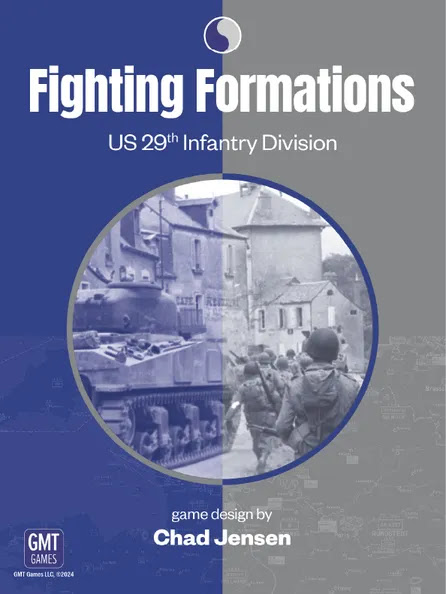
FIGHTING FORMATIONS - US 29th INFANTRY DIVISION
This new entry in the Fighting Formations series gives you more of everything you loved about the original, this time bringing the searchlight to shine on the exploits of a specific American division. Driven by the now classic initiative matrix —quite useful for barking orders all around in an organized manner—the game proposes a trove of scenarios of the small and large and holy-crap-this'll-take-all-night varieties, which makes it an ideal entry point for any newcomer.
(You can read my review here.)


#3

SETI
Scan the skies, launch probes, develop your technology and analyze all of the data you've gathered—and once you get in touch with actual aliens (because you will), make the best of what you manage to learn from our new friends.
Seti is one of those so-called Eurogames that sit right on the fence between heavy fare and gateway game; it's a challenging engine you can teach in a very reasonable amount of time, and even though your typical game will last around two hours, it won't feel like two hours. And that rotating solar system is just brilliant.
Whether you end up winning or losing, Seti makes it super engaging just to pull its lever and watch it go, and it certainly gets my vote for next year's Kennerspiel des Jahres (expert game of the year) in Germany.


#2

STAR TREK - CAPTAIN'S CHAIR
I was already a fan of the first few titles (known under the name Imperium) that use this civ-ish deckbuilding engine, but Captain's Chair takes everything to a new level. True, it is a more complex game, but it puts nothing out of reach of the average gamer. And it infuses the proceedings with more interaction between players than its older brothers ever provided.
I would go so far as calling it the best Star Trek game I've ever played while at the same time maintaining that you don't need to be a trekkie at all to thoroughly enjoy Captain's Chair. Just sit in it and see if you want to get up again.


#1

CIVOLUTION
There's always a smattering of Stefan Feld designs to be found around my blog, and this year is no different. Still, I've never encountered a Feld game quite like Civolution.
Players are superior intelligences more or less attempting to raise new civilizations in a lab. With more options at your fingertips—and enough stuff spilling out of the box to send you running to IKEA to buy an extra table or two—the game looks like it'll be impossible to digest. On the contrary, it's one of the most organic learning experiences you'll have encountered all year, and it's pure joy to see that engine run. Learn as you go, enjoy the discovery, and thank the graphic designers who came up with visuals that make everything crystal clear!


* * *

DISAPPOINTMENTS
I define disappointments as games I expected a lot from, and which failed to deliver. 
Here are the "top" three from 2024.


Martin Wallace has long been a favorite designer of mine, but his output has equally long been a hit-or-miss affair. And Aeterna sits unequivocally on the miss side of the line. The system is fine, I guess? But it's just that: a system. One that's looking for a game but also, more importantly, for a soul. And there's nary to be found here.

I'm always looking for THE pirate game that'll feel like it was designed just for me, and this one certainly is not that. Oh it's got heart and theme aplenty! It's just lacking everything else, especially meaningful player decisions. It's not because you're rolling dice on a thousand different tables that you're playing a game.
Look at it this way: If this were a computer game, the close-to-nil level of human input required to keep the thing moving forward would have people screaming bloody murder.


Is it an LOTR game? Sure. Is it a cooperative trick-taking thing? I am compelled to answer in the affirmative. Does it do anything that The Crew doesn't accomplish way, way better? Er, no. (Especially The Crew: Mission Deep Sea—just go play that and don't look back.)
This is just an inferior design that sells because it's got LOTR slapped all over it. Don't fall for the shiny trap.

* * *

STRAGGLERS
Let's end on a high note with three games that would have made my Top Ten had I encountered them back in the year when they were published.


With the Fischer-Spassky Championship for a backdrop, this little gem pulls a miniature Twilight Struggle of an engine to get your pulse racing in 30 minutes, no chess knowledge required. I can't believe it took me two years to get around to playing it.


There's something impressive about designing a two-player shedding game with minimal components and a core system that's so simple you can explain it in one sentence, and yet so deep your brain won't fully grasp its implications until you've played at least a few hands.
I was completely blown away by this.


Another cooperative game? 'Tis the season, it seems. This one has you and your favorite buccaneer trick-taking your way through treacherous waters, dry-as-bone islands, maelstroms and the actual kraken! With its magnificent components and clever mechanics, Sail will go a long way towards tempting me to dive into the legacy version that I hear is coming out in 2026.


# # #

Wednesday, December 10, 2025

The Play's the Thing


The existence of the most recent edition of Combat Commander made me wake up to two startling realizations.
First, my favorite game in the entire universe is celebrating its 20th anniversary. Already! And second, I’ve never written a proper review of this extraordinary opus.
Sure, I’ve penned a handful of articles about other entries in the series, but I never got around to typing an honest-to-goodness review of the game that started it all.
And I’m not going to do that today, either.

Rather, what I want to write is a love letter to the game I cherish most.

Why is it that, under normal circumstances, there’s a more than fair chance I’d rather play Combat Commander over anything else? What makes the contents of that box so appealing and so addictive? Why, oh why, after close to 600 plays (and we’re talking about a two-hour game, here), do I still anticipate with trepidation my next foray into those cardboard bunkers and hedgerows?
The answer to all of those questions is both simple and delightfully convoluted.

I met Chad Jensen—the man who would later give us Combat Commander—back in 1998, when I’d just set foot in northern California for a two-year stint at Lucasfilm. We lived in neighboring towns and our common passion was boardgames, so we were bound to run into each other before too long. We became friends; how could we not? Strangely enough, I showed him a prototype of mine the following year. (That game was Proteus, eventually published by Steve Jackson Games.) In return, Chad did—  well, nothing. He never showed me one of his designs, never even mentioned he was working on a handful of games. Nothing against me: Chad was just not the kind of guy who would have you taste a half-baked lasagna, even if it might be the best half-baked lasagna in the history of humankind. And so it was that I discovered that well kept secret about my friend along with the rest of the world in 2006, when GMT Games put out the title that would overrun so many others in my collection.

As of this writing, I have played well over 1,700 different games over the years, and I enjoy all kinds, from the purest of abstracts (something like GIPF) to bloated plastic dungeon crawlers (think Nemesis), and everything in between. But wargames hold a special place in my heart, for a wide variety of reasons. I had already played many of them by the time Combat Commander came along, but I had never experienced something quite like it.

So what is Combat Commander? It’s a tactical, WWII clash between two players that generally involves a low number of units operating across a constrained area. You move a bunch of units on a hex grid, attempt to take valuable objectives, eliminate threats, sometimes assaulting across lush fields in broad daylight, other times clearing one house after another in a bloody night raid supposed to be worth it all when the sun comes up.

Did you see what happened there? I started with a clinical description of basic game mechanics, but the story quickly took over.
THAT is Combat Commander.

The game tells a story. It also does many other things and does them well, but the story is what stays with you after the last gun was silenced and all the pieces have gone back into the box.

How does it tell that story? An excellent question.
And I believe the answer is to be found in three specific places.

They'll never take that hill... right?

1. ACTION RESTRICTIONS
Games allow players to make decisions in different ways. Some wargames allow each unit to act every turn, installing the player as ultimate master of their domain. Other systems provide a number of action points on each turn, leaving it up to the player to allocate said points amongst selected units, as they see fit; units thus activated can then perform whatever action is deemed necessary, but not all units will act on every turn. In yet other cases, the game will dictate which units can act, but allow the player to decide what actions to perform with them.
With Combat Commander, each player is dealt a hand of cards: those are the orders units can be given on that turn, usually one card to a unit or a handful of units. The order you had in mind doesn’t appear on any of your cards this turn? Tough.
This level of restriction is one of the highest in the wargaming realm, and yet—ironically enough—it’s from those shackles that true creativity can emerge with the most grace.

Picture a game of chess. Before your move, through the roll of a die, knights are rendered inoperable for one turn. Suddenly, the attack you had planned can’t proceed. Will you decide to maintain that attack? If so, how? And if you change your plan, what will it become? Will you opt for a holding pattern until Lady Luck paralyzes a piece of a different nature? Or settle for a retreat, hastily put together to compensate for your neutered forward thrust?
That’s how it goes with Combat Commander. The terrain ahead is ideal, your units are in place, one of the enemies in sight is already broken (making for an even better target)… You draw your hand of cards, and—thanks again to that mercurial Lady—you don’t hold a single Fire card. What do you do? You can skip your turn to throw away your hand of cards and hope you get some ammunition on the redraw, or you can try to make the best of a bad situation. Perhaps there’s a way to use your Rout card to push that wounded enemy soldier some spaces back, which would enable you to play one of your Move cards to get your own units even closer to your goal. Perhaps you decide instead to move a single unit towards a different objective, hoping to draw the enemy’s fire and make your opponent waste a precious Fire card—a card they will no longer hold should you move your men around at a later time. Or you could elect to hold fast and discard just those cards that wouldn’t be of any use against a counterattack that your opponent, faced with your inaction, might decide to launch.

Without anyone noticing, the story is taking shape. Instead of being “and then my guys started firing at the opposing squad,” it morphs into a more engaging “my guys wanted to shoot but couldn’t, so instead they had to resort to…”
See how memorable this is shaping up to be?

Some players detest the vagaries of such a system, stating that they prefer more control—fair enough. Combat Commander aficionados, on the other hand, relish those spur-of-the-moment challenges the game throws at us. In a way, we also feel it makes the proceedings a bit more realistic (to the extent that a tabletop game can lay such a claim), in the sense that in the heat of battle, not all of your orders will reach their intended recipients, and then not all orders that do will get executed without a hitch.

2. RANDOM EVENTS
This stands as another apple of discord amongst wargamers: Once in a while, a random event will throw a wrench in the proceedings. You or your opponent might receive unexpected reinforcements; a blaze could start in a building, spread to the nearby woods and cut off your main access point; air support might kill units you believed safe; off-board artillery could create a brand new foxhole for opposing units to exploit—the list goes on. While a category of players cannot stand this state of affairs, I (and many others) absolutely love it. Yes, I’ve been robbed of an inescapable victory—and been saved from certain defeat—more than once by those random events, and they’re still one of the main draws of Combat Commander for me. There’s something thrilling in the knowledge that the game will throw you a curveball, something you couldn’t possibly prepare for, and force you to deal with it. 

Again, this contributes to the story the game is writing. The lone team bleeding out in those northern woods and that everyone assumed was done for? Turns out a hero emerged, patched them up and led them out of those woods to fight another day.
You might not have planned for this, but now you need to reckon with that reality. Revise your analysis of the situation, edit your mindset, and contribute a new chapter to the narrative.

3. HISTORICAL SCENARIOS
Each game of Combat Commander runs on parameters established by a scenario, which specifies the forces involved, the number of turns the game will last, hand size for each player, and so on. GMT has published over 100 official scenarios, almost all of which are based on actual WWII engagements. Reading the historical summary before the opening salvo is a ritual we rarely skip: it pries open the narrative door and lets in the winds of fate. 
Which makes the entire experience even better: not only does each game craft a story that both players contribute to, but that emerging tale is also based on true events. How amazing is that? True, most wargames reenact a historical situation, but none of them allows you to add your own ingredients to the story with such dramatic flair.
(And if you’re still not sated, the system’s robust random scenario generator will spit out period-appropriate skirmishes to keep your imagination engaged until the cows come home.)

A typical Combat Commander scenario

The level of creativity made possible by the combination of those three elements is not a frequent occurrence in gaming, and even rarer of a phenomenon when it comes to wargames. Combat Commander provides players with a sandbox and hands over quite a lot of freedom as to how players will interact with it, but it also litters the sandbox with a bunch of mines that force players to be creative, lest they don’t survive the experience.
That’s how stories emerge, and that’s how we can’t help but remember them.
(I still vividly recall a session from a decade ago where a hero kept calling for artillery support, only to see those shells drift back far enough to fall on his own troops. Again and again, at least half a dozen times. Laughing so hard we needed to grab the table so we wouldn’t fall off our chairs, it was clear to us the story was running wild: we wondered if some strange and powerful wind had anything to do with the repeated shell malfunctions, or if our beloved hero was just the most inept soldier ever to grace a battlefield, transmitting erroneous coordinates every time he contacted HQ. We still debate the issue to this day, with a grin the passing years have not yet begun to erode.)

And the game keeps on giving. I mean, after over a thousand hours spent playing Combat Commander and interacting with its myriad systems, I still witness stuff I’ve never encountered before: a bold new use for a card, a surprising tactic born out of pure desperation, a concurrence of events that give birth to an astounding situation, or just a unit that—against all odds—refuses to give in and ends up carrying the day.

* * *

My friend Chad died in 2019, after a valiant battle against cancer. Because I had moved back to the other end of the North American continent, I never got a chance to sit down to a game of Combat Commander with him. Sure, online options had surfaced by then, but we kept putting it off, convinced we’d get a chance to sit face-to-face for a lively match one of those years. Alas, that opportunity never presented itself.
Despite everything, I’m thankful I was afforded the chance to tell Chad, over a long overdue phone call, how much happiness his creation (one of many!) had brought into my wargaming life. At that he responded by being Chad, simply saying “you’re welcome” with a smile I could hear in his voice from five thousand kilometers away. 

Every time I crack open my box of Combat Commander I can still hear that smile, clear as a bell, crisp as that spring morning back in ‘45, when the days were growing warmer and the evenings longer...


# # #


Wednesday, November 26, 2025

Flash Review — Eagles in the Sky


Players
Age: 12+ 
Playtime: 15-240 min (for the campaign game!)
Complexity: 8/10

Take to the heavens in your trusty Sopwith Camel and try to get into an advantageous position behind that Fokker DR.I with the red livery... before he does it to you first.

Recent games that model air combat during the Great War are few and far between, which makes Eagles in the Sky all the more inviting. And coming from Revolution Games, the package was too hard to resist.

The game runs on a system of relative positions: there's no map across which aircraft glide and try to find each other. Rather, if you spot an enemy at your altitude (or manage to climb or dive to meet them there), you can play a card whose value gets added to the relevant maneuver rating of your aircraft. And if the opponent can't match that sum, you'll find yourself tailing them and in a position to shoot. Then it's all a matter of better exploiting the enemy's weaknesses so you can improve your position and keep tailing them until you can send their flying machine down in flames. 
But that's assuming they won't manage to shake you off their tail—or worse, turn the tables and start shooting back!

A single engagement (either historical with set parameters, or generated randomly using a series of handy tables) can be over in as few as 15 action-packed minutes. The real jewel, however, is to be found in the campaign system, which strings together five intense days of sorties with a variety of missions: strafing trenches, taking down balloons, bombing enemy positions, the classic patrol, and more.
Be mindful of the weather, track your hardware, repair and replace aircraft, train new pilots, and just pray they survive long enough to get better at the job and—we can only hope—one day turn into aces.

The game is fast and fun, with even campaign games short enough to keep you hungry for more.

Most easily forgotten rule: When you're tailing an aircraft in a climb, you can only attack it using a Climb maneuver card.


# # #

Friday, September 5, 2025

Flash Review — Sail


Players2
Age: 11+ 
Playtime: 20 min
Complexity: 4/10

Cooperative trick-taking games were unheard of just a few years ago, and then The Crew came along to show the world just what we'd been missing.
Sail is another one of those, similar in some ways to Jekyll & Hyde vs Scotland Yard, but this time pitting two partners against the dangers of the high seas.

The game is played with a three-suited card deck and a grid of diamond spaces, where players work together to get their pirate ship to its destination while avoiding the dreaded Kraken. This is accomplished through a series of tricks: one player lays down a card, and the other must follow suit if they can, or else play any card from their hand.

Each card shows a number (from 1 through 9) along with a symbol, and the combination of symbols played by both players determines what happens next. Two steering wheels? Move the ship one space forward, in the direction of the player who won the trick. A wheel/tentacle and a cannon? The ship stays put, but the wheel/tentacle card goes to the Kraken deck (more on this below). Two mermaids? Move the ship forward across the diamond diagonal—that's like two moves in one!
And so on.

Halfway through the learning scenario

Whenever the Kraken would attack the ship (there are multiple cases when this happens), discard a specified number of cards from the Kraken deck. If the Kraken deck ever runs out of cards, the ship sinks and the game is lost.
But make it in one piece to one of the end spaces, and victory is yours!... Until the next scenario, which makes life unavoidably more difficult for the players.

Sail is a real gem of a game, with beautiful art, addictive gameplay and a conveniently small footprint.

Most easily forgotten rule: There's not much to forget here, but how about this—at the end of each round, the Kraken attacks the ship a number of times equal to the value under the Kraken meeple on the Kraken board.


# # #

Wednesday, July 23, 2025

Lucas Land: Prince of Darkness

  (Previous chapter: ID Please)


Over my two years as web writer 
and then editor of starwars.com, I happened to run into my share of celebrities. Protocol dictated that Lucasfilm employees would refrain from drooling all over themselves whenever one star or another walked in—as they were wont to do—but it didn't mean some of those encounters would leave any less of a mark, no matter how cool you played it at the time.

There was the big man himself, George Lucas, on a couple of occasions; personal heroes of mine such as sound designer Ben Burtt (busy mixing Episode I, no less); actors the likes of Robert Redford, devastatingly handsome as always and having dinner at one of the Skywalker Ranch restaurants; and a host more, either properly introduced and greeted in the flesh with a handshake, or else glimpsed en passant which was sometimes even more charming.

And then, surprisingly, there was Ozzy Osbourne.

The affair took place at Skywalker Ranch on May 17, 1999—a mere two days before the official release of Episode I. As part of the big fanfare for the new Star Wars movie, an assortment of artists had been invited to attend what was labeled the MTV Premiere. The event consisted of a grand gathering on the grounds of the Ranch, a cornucopia of items to eat and drink (and at least twice that number of photo ops), with a handful of official speeches followed by an advance screening of The Phantom Menace
And as the in-house reporter, I was sent to the scene of the crime and tasked with reporting on the proceedings. 

There were a ton of people pouring in. I remember seeing Paul Rudd and Carmen Electra, just as I recall walking by Ryan Reynolds and almost running into Bruce Boxleitner (TRON, man!). At some point I noticed Elijah Woodand I'm told Orlando Bloom was also in attendance, although I hadn't yet seen him in anything at that point. Edward Furlong showed up, then Usher, and a veritable torrent of actors and musicians and models that no dam could stop. Not to mention notable elements from the cast and crew.

For a while I just stood around with a glass in my hand, smiling and wondering what I'd end up reporting, because in the end there wasn't a whole lot to write about: it was a show for the MTV camera crew and little else. A man all dressed in black (leather pants), with long slick hair and sunglasses, andlike mecarrying a drink he didn't seem to know what to do with, walked up to me and asked how I was doing. 
The Prince of Darkness.

We ended up talking for the better part of a half hour, discussing life, death, philosophy. He had made the trip with one of his kids, and as we watched him running around in the grass that always seemed greener at the Ranch than anywhere else, Ozzy told me that life was moving fast and that I had to make sure I took it all in. "Still, take time to breathe, in and out. We'll be dead before we know it: we have to make it last."
So I stood there next to him. Breathing in and breathing out, with Ozzy Osbourne. Neither of us touching our drinks.

He didn't take off the shades, of course, which means I never got to really look the man in the eye. As he excused himself (without a handshake, I was sorry to notice) wished me good day and ambled off, I felt a strange connection like nothing I experienced before or since. As if I'd been visited by the spirit of an unexpected mentor who'd imparted some ancient wisdom to the eager youngster that I was, before gently floating away, his task accomplished.

It took me a while to realize we'd never even talked about Star Wars.
But in a way, that's all we talked about.

(Next chapter: Hero Worship – coming soon)

(Full series here!)


# # #

Tuesday, July 1, 2025

Wargame review — Fighting Formations: US 29th Infantry Division

Twenty-Nine, Let's Go!

Designer: Chad Jensen
Player count: 2
Publisher: GMT Games


(I was convinced I had written a review of the original Fighting Formations game, 14 years ago. But I was wrong! It's high time I remedy the situation, using the newly minted entry in the growing series as a convenient excuse...)


Much like the original Fighting Formations volume, this game shines a searchlight on a specific division that saw heavy action during WWII
—this time on the American side, with the 29th Infantry Division.
It's also another design that Chad Jensen left incomplete with his untimely passing, and which Kai Jensen and John Foley helped across the finish line.

And it's a damn good game.

The US 29th Infantry Division (also called the Blue and Gray Division, if you were wondering about design choices for the game's cover) was part of the very first wave of troops that landed on Omaha Beach on D-Day, and fought their way all across western Europe and deep into Germany, where they made contact with Russian units. Their exploits are numerous, and this volume touches upon some of that history.

Some of the moving parts might feel familiar: In some ways, Fighting Formations stands as one more item amidst a vast catalogue of traditional hex-and-counter games, what with its hex grid showcasing various terrains, units with an array of different stats, lines of sight, attack bonuses and the likes. But it's also a breath of fresh air when it comes to command systems, activation costs and the wargame imperative to do something now in case you're prevented from doing it later.

The game runs on an initiative system built like a tug of war between two factions, with a pawn that swings back and forth and provides operational opportunities—at a cost.
Every scenario starts with the Order Matrix being seeded (generally at random) with 10 order cubes. Those cubes represent everything both sides can accomplish during the upcoming turn: when it's your go, take a cube from the Matrix, pay the associated initiative cost (from the row the cube was sitting on) by moving the initiative pawn towards your opponent, and execute that row's order or any other order below it. 


The Germans could play up to three orders
before the Americans get one. But will they?

(You might have noticed in the above image that the same order has different initiative costs, depending on the side attempting to perform it. This is a clever method to balance the Order Matrix in a way that takes into account the relative strengths and weaknesses of the factions facing each other. And yes, it's different from one Fighting Formations volume to the next.)

When you're done with your current order, look at the position of the pawn on the Initiative Track: if it still stands on your side of the zero space, then you can go again! Otherwise your opponent gets to pick an order. 

Initiative cost does not stop at the order itself, however, as you also have to take into account what units you're ordering around. That's where command markers come into play: think of them as floaty leaders that can appear at anytime and in whatever space you need them. Wherever you plop one down, it commands each and every unit within its command radius (with a starting value of around 3 hexes, depending on the scenario). If you order a unit within the radius of a fresh command markerlabeled "mission command"you incur no additional initiative cost, whereas an ordered unit within the radius of a turn-old command markerlabeled "tactical command"will increase your initiative cost by 1, or even by 2 should the unit not happen to be within a command radius at all.

In other words, you can give an order to any of your units on the board. But how much initiative are you willing to hand over to your opponent so that you can make this happen?

Some of those precious Command Markers.
Use them wisely.

Said orders include Move (which accomplishes just what you'd expect), Assault (move a little less but fire while doing so!), Advance (move just 1 hex but avoid opportunity fire), Rally (patch up those damaged units), Support (draw some powerful Asset cards), Asset (play those powerful Asset cards) and something you'll want to do early and often, Fire.

That Fire order gives way to an ingenious combat system based on dice sizes, and where modifiers, well, modify the size of the dice you end up rolling. 
Start with a pair of 10-sided dice. Shooting at an adjacent hex? Go up one size (to d12). Aiming at something in the flank fire arc of your tank while you're assaulting? Go down two sizes, all the way to d6. Sure, you can always roll snake eyes no matter what, but there's an appreciable difference between taking out an MG 42 using d12s, and hoping it doesn't decide to return fire when you're annoying it with a pair of d6s...

When you do hit something, your opponent makes a roll of their own in their defense. Failure means a hit marker is drawn at random out of a cup and assigned to the damaged unit. Some markers indicate the unit can't move or fire (or both!) anymore, but anytime a unit would get a second hit marker, it's eliminated instead.

Getting rid of those markers is a matter of paying for a Rally order and rolling equal to or higher than the target number on each marker. A successful roll removes the hit marker, while rolling short of the target number can mean either that nothing changes (with a black number) or that the unit is eliminated (with a red number).

No, no, my tanks are not in trouble at all.
What makes you say something like that?

Now, there's a big difference between mostly dead and all dead.
If the eliminated unit was a platoon (with three little black bars in its top left corner), then it turns into two squads of the same type. In essence, one third of your platoon got wiped out, but the other two thirds carry on fighting.
(Deploying in this manner is something you can do whenever you activate a platoon, just as you can muster three undamaged squads of the same type back into a single platoon marker.)
When your opponent does this switching out as a result of combat, it might feel like you're endlessly whittling down their forces. But when it happens to you? It's your men's life force that's slipping through your fingers. And fast.

A turn ends at the conclusion of the last order cube removed from the Matrix. A series of maintenance steps and checks is performed, and the Order Matrix is reseeded anew, at random. Give those d10s a good shake!
The game reaches an end between two turns when the Sudden Death dice roll comes up short of a predetermined value (set at start by the scenario, and which keeps increasing over time), with
—usuallythe player having racked up the most points (through various objectives) taking home the victory.


WAR PRODUCTION

This incarnation of Fighting Formations ships with a deeper box than its predecessors, and it's not a centimeter too deep considering everything that needs to reside inside. Dice, decks of Asset cards and a slew of counters aside, the provided equipment includes 10 back-printed paper maps, a handful of player aids, and four rulebooks: the series rulebook (common to all games using this system), an Examples of Play book, a playbook featuring rules exclusive to this title as well as design notes and other assorted delicacies, plus a scenarios book with 13 mouth-watering engagements—including a Scenario 0 to get new players started using a low unit count and a constrained map.
Oh, and wooden cubes and pawn!

My only gripe in this case concerns the player aids: I wish we'd gotten two copies of each. The game is perfectly playable with just the one, but I like to follow along when my opponent grabs the barrage table to calculate their next act of utter carnage.


RULES OF ENGAGEMENT

With its 25 pages of rules, Fighting Formations comes down on the low side of the page-count barrier as it pertains to typical wargames. And since it's a Jensen rulebook, you know it'll be a pleasant and effective read, doubling as an excellent rules reference tool in the heat of the action. It's not a difficult game to learn as every concept flows naturally into the next one; and despite featuring numerous innovations, the system feels intuitive, with things unfolding mostly the way you expect them to.

If you prefer your indexes close at hand (and I certainly do), know that this one is located at the tail end of the playbook. It encompasses both the series rules as well as the exclusive rules, for your perusing pleasure.

New to the systemor, like me, rusty as all get out? The extended Examples of Play book has you covered with 20 pages of profusely illustrated, detailed examples. You'll learn about assaults, melees, the dreaded triple-cost reverse move (painful when you must do it), and the artillery barrage, among plenty of other delightful happenings.

Mostly, you'll refer to the player aids: they contain most of what you'll need to get to the end of a scenario, win or lose.


FUN FACTOR

Fighting Formations has always been a really fun game to play. It is a longer game than what's on offer with Jensen's most famous design, Combat Commander, the latter clocking in at an average of two hours. When the original FF title came out, I remember players complaining about game length, roughly double that of your typical CC scenario. Which sounded strange to me, given that a lot of hex-and-counter wargames—if not the majority—promise a play time that hovers in the four-hour range. But I guess they had a point, in that since FF looks some much like CC, and shares so many of those high-octane, back-and-forth moments of action, you might easily be lulled into expecting a similar game length.

What didn't help, though, was that the original FF scenarios tended to land at the "very long" end of that spectrum. Only one of the so-called "five-turn scenarios" was provided, and even one of those can easily stretch to four hours; the rest poured well above and beyond that let's-do-this-in-an-evening line of demarcation.
Some years later, the Kharkov expansion came along to somewhat alleviate the issue, and I'm happy to report that the Blue and Gray volume follows that lead, with eight "five-turn scenarios," four longer scenarios, and one absolute monster of a sandbox clash I have yet to experience but which I'm looking forward to very much (probably as a weekend endeavor with a hardened partner).


PARTING SHOTS

If you're already familiar with the Fighting Formations system, then you already know how to play this volume. It's a standalone game, but apart from a handful of differences when it comes to terrains, assets and special actions, it runs on the same rules as the original game.

Just like its predecessor, this new volume includes an optional event system that I strongly encourage you to use in every one of your games. It throws a wrench into the proceedings that forces you to adapt to unforeseen developments—and shouldn't every wargame be about just that?

I began this review by writing that the US 29th Infantry Division has seen combat from D-Day all the way through to the end of the Second World War, and I can't help but notice that the last scenario, chronologically, takes place in November of 1944. So that leaves plenty of space for future expansions to further explore the engagements the Blue and Gray Division took part in.

Right??


# # #